
An electrical service agreement is a contract that defines the ongoing electrical maintenance, inspections, and repair services a provider delivers to your property over a set period. Unlike a one-time project contract, service agreements cover scheduled maintenance and emergency terms across months or years. What electrical service agreement covers directly affects your safety, your budget, and your legal protections as a homeowner or property manager. Understanding the electric service coverage details before you sign is the difference between a plan that protects you and one that surprises you with gaps.
What does an electrical service agreement cover?
Most electrical service agreements cover three core categories: scheduled maintenance, safety inspections, and defined repair services. The annual safety audit is the backbone of nearly every plan, covering electrical panels, circuit breakers, GFCI and AFCI outlet testing, smoke and carbon monoxide alarm checks, and visual inspections for overheating or code violations. That single annual visit catches the problems most homeowners never notice until something fails. Beyond the audit, what is included in a service agreement varies by tier, but the following components appear in most standard plans:
- Panel and breaker inspection: Technicians check for loose connections, corrosion, and signs of overloading that could cause fires or tripped breakers.
- GFCI and AFCI testing: Ground fault and arc fault circuit interrupters are tested to confirm they trip correctly, a requirement under the National Electrical Code for kitchens, bathrooms, and bedrooms.
- Routine visual inspections: Technicians scan visible wiring, junction boxes, and outlets for heat damage, improper installation, or code issues that could trigger a failed inspection.
- Covered repairs: Many plans include labor for minor repairs discovered during inspections, such as replacing a faulty outlet, tightening panel connections, or swapping a defective breaker.
- Priority scheduling: Agreement holders typically move ahead of non-contract customers when booking service calls, reducing wait times for non-emergency work.
Coverage exclusions matter just as much as inclusions. Failures caused by extreme weather, unauthorized third-party work, or abnormal electrical conditions are commonly excluded from coverage. A plan that looks thorough on the surface can leave you unprotected if those exclusions are buried in fine print.
Pro Tip: Ask your provider for a written list of both inclusions and exclusions before signing. A reputable contractor will provide this without hesitation, and it protects both parties from disputes later.

Key contract terms homeowners need to understand
Electricity contract terms define the legal boundaries of what you are buying. Service agreements legally define scope, payment terms, termination rights, warranties, liabilities, and dispute resolution procedures to protect both the homeowner and the provider. Reading past the service list to the contract language is where most homeowners find surprises. The five terms that matter most are:
- Scope of services: This section lists every service included and explicitly excluded. If a service is not listed here, assume it is not covered. Vague language like “general maintenance” without specifics is a red flag.
- Payment terms and billing cycles: Plans charge monthly or annually. Monthly billing offers flexibility, but annual prepayment often comes with a discount. Confirm whether fees auto-renew and whether rates can increase mid-term.
- Term, renewal, and cancellation policy: Most agreements run 12 months with automatic renewal. Cancellation terms vary widely. Some plans allow cancellation with 30 days’ written notice; others charge a cancellation fee equal to several months of service.
- Warranties and liability limits: A solid agreement specifies the warranty period on any repair work performed under the contract. Liability clauses cap what the provider owes if something goes wrong, so read these carefully before assuming full protection.
- Customer responsibilities: You are typically required to provide safe access to the property, maintain the electrical system between visits, and notify the provider of any changes made by third parties. Failing to meet these obligations can void coverage on specific claims.
Explicit lists of inclusions and exclusions are the single most effective tool for preventing customer disputes. If your agreement uses general language, request an addendum that spells out specifics before the contract starts.
How emergency and priority services work under these agreements
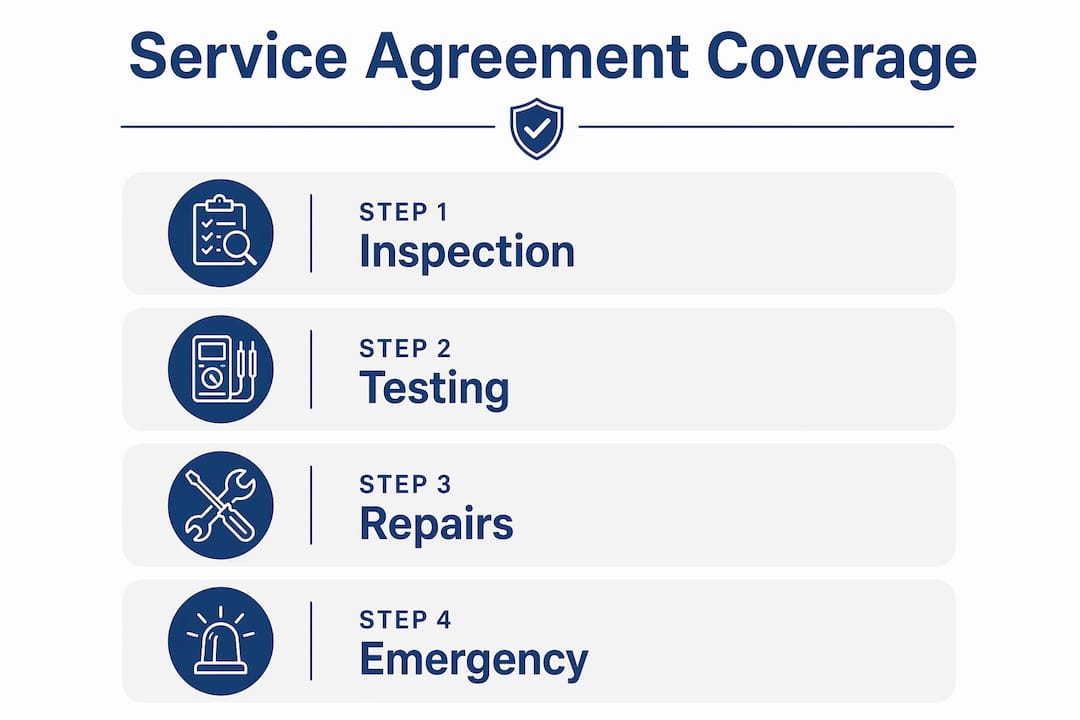
Emergency service terms are one of the most misread sections of any electrical maintenance plan. Emergency services are prioritized but not guaranteed, meaning your agreement gives you front-of-line status without committing to a specific arrival window unless the contract explicitly states one. That distinction matters enormously when you have a tripped main breaker at 10 p.m. on a Friday.
Here is what to look for in the emergency service section of your agreement:
- Response commitment language: Look for phrases like “priority scheduling within 24 hours” versus “same-day guaranteed response.” Only the second phrase creates a binding obligation.
- Authorization procedures: Emergency work may require verbal or written approval before work begins, followed by formal service documentation within a set number of business days. Skipping this step can complicate billing and void warranty coverage on that repair.
- After-hours billing: Many plans cover labor during standard hours but charge a premium for nights, weekends, or holidays. Confirm whether your plan absorbs those rates or passes them to you.
- Scope limits on emergency calls: Some agreements cap the dollar value or type of work performed on emergency visits. A technician may restore power but defer a panel replacement to a scheduled appointment.
Pro Tip: Before an emergency happens, save your provider’s emergency line in your phone and re-read the authorization section of your agreement. Knowing the process in advance saves time and prevents billing disputes when you are already stressed.
For Grand Strand homeowners, having a generator service plan alongside your electrical agreement adds a critical backup layer when coastal storms knock out grid power for extended periods.
What does an electrical service plan cost?
Electrical service plan pricing follows two main models: monthly membership fees and annual prepaid plans. Example pricing tiers in the industry range from $25 to $50 per month for base plans and $45 to $100 per month for premium or summit-level plans. Those numbers reflect national averages, and local market rates, property size, and coverage depth all shift the final figure.
| Plan tier | Typical monthly cost | What it generally includes |
|---|---|---|
| Base plan | $25 to $50/month | Annual inspection, priority scheduling, minor repairs |
| Mid-tier plan | $50 to $75/month | Base coverage plus GFCI/AFCI testing, panel audit |
| Premium plan | $75 to $100+/month | Full audit, emergency priority, extended repair coverage |
| Annual prepaid | Varies (5 to 15% discount) | Same as chosen tier, paid upfront for reduced rate |
Three factors drive cost variation more than any other. First, coverage level: a plan that includes labor for repairs costs more than one that covers inspections only. Second, property size and complexity: a 4,000-square-foot home with a 200-amp panel and a detached garage sub-panel requires more inspection time than a 1,200-square-foot condo. Third, cancellation terms: plans with no cancellation fees typically charge higher monthly rates to offset the provider’s risk.
Annual prepayment usually delivers the best value if you plan to stay in the property. Monthly plans make sense for rental properties or situations where coverage needs may change. Either way, confirm whether cancellation mid-term triggers a prorated refund or a flat penalty fee.
Service agreements vs. one-time electrical contracts
The fundamental difference between an electrical service agreement and a one-time electrical contract is ongoing maintenance versus a single defined project. Both are legally binding, but they serve completely different purposes.
| Feature | Service agreement | One-time contract |
|---|---|---|
| Duration | 12 months or longer, often auto-renewing | Single project with defined start and end date |
| Services covered | Ongoing inspections, maintenance, and repairs | Specific scope: panel upgrade, rewire, installation |
| Billing structure | Monthly or annual recurring fee | Fixed project price or time-and-materials |
| Emergency coverage | Priority scheduling included | No ongoing emergency terms |
| Best suited for | Homeowners wanting ongoing safety and maintenance | Renovation projects, new installations, one-time repairs |
A one-time contract is the right tool when you need a specific job completed: installing an EV charger, upgrading a panel, or wiring a new addition. A service agreement is the right tool when you want a provider accountable for the ongoing health of your electrical system. Many homeowners use both. They hire a contractor for a specific project under a one-time contract, then enroll in a service agreement to maintain the system afterward. The residential electrical services you need depend on where you are in that cycle.
Key takeaways
A well-structured electrical service agreement defines exactly what maintenance, inspections, and repairs your provider delivers, and what they do not, protecting you from unexpected costs and system failures.
| Point | Details |
|---|---|
| Core coverage components | Annual safety audits, GFCI/AFCI testing, panel inspections, and priority scheduling form the foundation of most plans. |
| Exclusions matter | Failures from extreme weather, third-party work, or abnormal conditions are commonly excluded and must be reviewed before signing. |
| Emergency terms are not guarantees | Priority scheduling means front-of-line status, not a guaranteed arrival window, unless the contract explicitly states one. |
| Cost scales with coverage | Base plans run $25 to $50 per month; premium plans reach $100 or more, with annual prepayment offering the best per-visit value. |
| Agreements vs. one-time contracts | Service agreements cover ongoing maintenance; one-time contracts cover a single defined project. Use both strategically. |
What I have learned from reading electrical service agreements closely
Most homeowners sign electrical service agreements the same way they accept software terms of service: quickly, without reading past the first page. That habit is expensive. The sections that protect you most are the ones buried deepest: the exclusions list, the cancellation penalty clause, and the emergency authorization procedure.
The pricing tier table looks straightforward until you realize that a base plan covering inspections only leaves all repair labor as an out-of-pocket cost. A $30-per-month plan that excludes repair labor is not a bargain if a single service call runs $200. The math only works in your favor when the plan covers labor, not just the visit.
Emergency service language is where I see the most frustration. Homeowners read “priority service” and assume it means fast service. It means faster than a non-contract customer, which could still mean a next-day or two-day wait during a busy period. If same-day emergency response matters to you, that phrase needs to appear in writing in your contract. Anything less is a marketing promise, not a legal one.
My strongest recommendation: treat the exclusions list as the real definition of your coverage. What the agreement does not cover tells you more about its value than what it does. Request that list in writing, compare it against your property’s specific risks, and negotiate additions before you sign. Coastal properties in the Grand Strand face corrosion, storm surge, and humidity-related electrical issues that inland properties do not. Your agreement should reflect those realities, not ignore them.
— SEO
Reliable electrical service for Grand Strand homeowners

Gregbeverlyservices brings over 40 years of electrical experience to residential and commercial properties across the Grand Strand. Whether you need a clear explanation of what your current agreement covers or want to build a service plan tailored to your property’s specific needs, the team at Gregbeverlyservices delivers transparent guidance without the guesswork. From routine safety inspections to priority emergency response, their residential electrical services are structured to give homeowners and property managers real protection. For properties that depend on backup power during coastal storms, their generator maintenance services add a critical layer of reliability. Contact Gregbeverlyservices to discuss a service plan built around your property and your budget.
FAQ
What does a standard electrical service agreement include?
A standard electrical service agreement includes an annual safety inspection covering panels, breakers, GFCI and AFCI outlets, and smoke alarms, plus priority scheduling for service calls. Many plans also include labor for minor repairs found during inspections.
Are emergency electrical services guaranteed under a service agreement?
Emergency services under most agreements are prioritized, not guaranteed. Priority scheduling moves you ahead of non-contract customers, but a specific arrival window is only binding if the contract explicitly states one.
What is typically excluded from electrical service agreements?
Most agreements exclude failures caused by extreme weather events, unauthorized third-party work, or abnormal electrical conditions. Always request a written exclusions list before signing to understand the plan’s real limits.
How much does an electrical service agreement cost per month?
Base plans typically run $25 to $50 per month, while premium plans range from $75 to $100 or more. Annual prepayment usually reduces the effective monthly cost by 5 to 15 percent compared to month-to-month billing.
What is the difference between a service agreement and a one-time electrical contract?
A service agreement covers ongoing maintenance and inspections over 12 months or more. A one-time contract covers a single defined project, such as a panel upgrade or new installation, with no ongoing obligations after completion.