
A residential construction electrical phases checklist is the structured tool that keeps every wiring milestone on track, from the first conduit run to the final breaker test. Without it, builders and homeowners risk failed inspections, costly rework, and code violations that delay occupancy. The National Electrical Code (NEC) sets the compliance standard for every phase, and inspectors in jurisdictions across the Grand Strand and beyond use it as their benchmark. This guide breaks down each phase, the critical checklist items within it, and the practical steps that produce a first-pass inspection approval.
1. What are the main electrical phases in residential construction?
Residential electrical work follows a defined sequence that mirrors the construction timeline. Understanding that sequence is the foundation of any solid electrical checklist for home construction.
The four core phases are:
-
Planning and design. This phase covers load calculations, circuit layout, panel sizing, and permit applications. Your electrical plan must be approved before any wire is pulled. At this stage, you identify where AFCI and GFCI protection will be required, where the service entrance lands, and how many circuits each room needs.
-
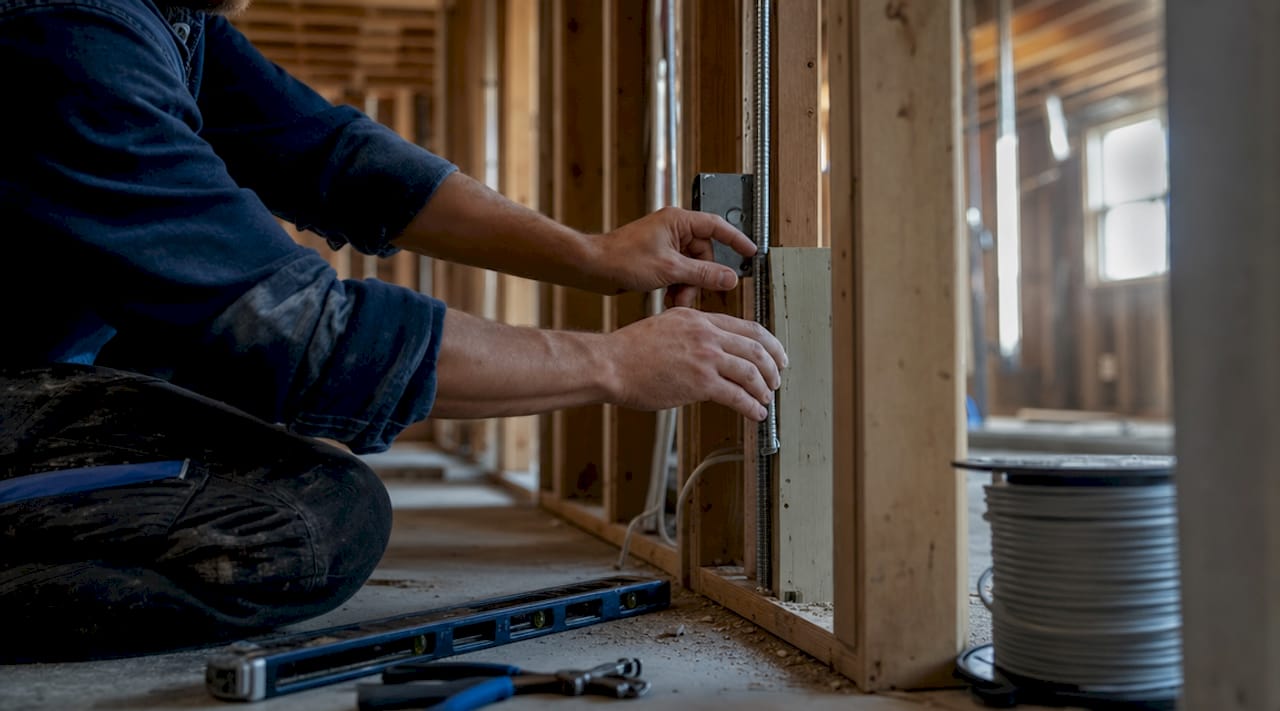
Rough-in. Wiring is run through framing, boxes are set, and cables are secured before drywall goes up. Rough-in inspection occurs after wiring is run but before drywall is installed, making it the most critical visibility window in the entire project.
-
Service and equipment inspection (where applicable). Some jurisdictions require a separate inspection for the meter base, service entrance conductors, and main panel before the utility connects power. Check with your local authority having jurisdiction (AHJ) to confirm whether this applies to your build.
-
Final inspection. Devices are installed, the panel is energized, circuits are labeled, and all protective devices are tested. Final inspection happens after devices and panels are installed and circuits are energized.
Skipping or rushing any phase creates compounding problems. A missed rough-in detail discovered at final inspection means opening walls. A panel labeled incorrectly at final means a failed inspection and a return visit from the inspector. Sequencing matters as much as the work itself.
2. Key checklist items for the rough-in electrical phase
The rough-in phase is where most code violations originate, and it is the phase inspectors scrutinize most closely. Every item below must be verified before you call for inspection.
- Box fill calculations per NEC 314.16. Count conductors, devices, and fittings in every box. Overfilled boxes are a top rough-in failure reason. Use the NEC table to confirm cubic-inch requirements before setting boxes.
- Cable securing within 12 inches of boxes per NEC 334.30. Every cable must be stapled or clamped within 12 inches of each box and at intervals not exceeding 4.5 feet. Loose cable is an automatic fail.
- Nail plate protection. Anywhere a cable passes through a stud or joist within 1.25 inches of the edge, a steel nail plate is required. Inspectors probe for these with a magnet or visual check.
- Receptacle spacing per NEC 210.52. No point along a wall should be more than 6 feet from an outlet. Measure every wall run, including short walls beside doorways.
- AFCI protection planning per NEC 210.12. AFCI protection is mandated in dwelling-unit branch circuits supplying outlets in most habitable rooms, including bedrooms, kitchens, and living areas. Confirm your panel has AFCI breaker slots allocated for every required circuit.
- Grounding and bonding. Ground wires must be present in every cable run. Verify continuity from boxes back to the panel ground bar.
- All junction boxes accessible. No box may be buried behind drywall. Every junction box must remain open and visible for the inspector.
Pro Tip: Walk every room with a tape measure and a copy of NEC 210.52 before calling for rough-in inspection. Catching a missing receptacle location costs 20 minutes to fix before drywall and potentially two weeks of delay after.
Closing walls before passing rough-in often leads to costly demolition and rework, as safety-critical wiring details become inaccessible. This is the single most expensive mistake on any residential build.
3. Checklist essentials for the final electrical inspection
The final inspection is a circuit-by-circuit functional audit, not just a visual check. Treating it that way from the start produces better outcomes.
- GFCI protection per NEC 210.8. GFCI protection is required in every receptacle in kitchens, bathrooms, garages, outdoors, basements, and within 6 feet of sinks. The 2023 NEC expanded kitchen GFCI requirements beyond countertops to include all receptacles for appliances. Test every GFCI outlet with a dedicated tester before the inspector arrives.
- Panel directory labeling per NEC 408.4. Every circuit must be identified clearly and accurately. Vague labels like “bedroom” are insufficient. Use room-specific descriptions: “Master bedroom outlets,” “Kitchen refrigerator,” “Garage door opener.”
- Working space clearance per NEC 110.26. NEC 110.26 requires 36 inches of depth, 30 inches of width, and 6.5 feet of headroom in front of the panel. No storage, shelving, or construction materials may occupy that space on inspection day.
- Tamper-resistant receptacles. All 15A and 20A receptacles in dwelling units must be tamper-resistant per NEC 406.12. Verify the “TR” marking on every device before installation.
- Weather-resistant receptacles. All outdoor and wet-location receptacles require weather-resistant (WR) rated devices in addition to in-use covers.
- Smoke and carbon monoxide detectors. Confirm placement meets local code: typically inside each bedroom, outside each sleeping area, and on every level of the home.
- AFCI breaker function test. Press the test button on every AFCI breaker. A breaker that does not trip is a failed device and a failed inspection.
- Cover plates and panel fronts. Every device box needs a cover plate. The panel dead front must be installed with all knockouts filled.
Pro Tip: Build a room-by-room final checklist on a clipboard and physically check off each item as you walk the house. Inspectors notice when a builder is organized. It signals quality work and often results in a faster, more cooperative inspection.
The table below summarizes the NEC code sections most referenced during final inspections:
| NEC Section | Requirement | Common Failure |
|---|---|---|
| NEC 210.8 | GFCI protection in wet and hazardous locations | Missing GFCI in garage or basement |
| NEC 408.4 | Panel circuit directory labeling | Blank or vague circuit labels |
| NEC 110.26 | Working space clearance at panel | Materials stored in front of panel |
| NEC 406.12 | Tamper-resistant receptacles in dwelling units | Standard receptacles installed instead of TR-rated |
| NEC 210.12 | AFCI protection in habitable rooms | Non-AFCI breaker on bedroom circuit |
4. Common electrical inspection failures and how to avoid them
About 25% of residential electrical inspections fail on the first pass, with missing or non-functional GFCI protection cited as the most common reason. First-pass failure rates range from 15 to 40%, and every failed inspection adds scheduling delays and reinspection fees. The failures below account for the majority of those outcomes.
- Missing GFCI or AFCI devices. Builders sometimes install standard breakers or receptacles in locations that require protection-rated devices. Cross-reference NEC 210.8 and 210.12 against your circuit list before final.
- Exceeding box fill limits. Cramming extra conductors into a box to save time creates a code violation. Calculate fill before setting boxes, not after.
- Blocked panel working space. Blocked working space is a frequent fail reason during final inspections, and it has nothing to do with wiring quality. Clear the panel area completely before the inspector arrives.
- Improper cable securing and missing nail plates. Inspectors probe for loose cable and unprotected penetrations. Both are quick visual fails that are entirely preventable.
- Unlabeled panel circuits. A blank panel directory is a code violation under NEC 408.4. It also signals to the inspector that the work may be incomplete elsewhere.
- Premature drywall closure. Closing walls before rough-in approval is the most expensive mistake on any build. Inspectors must see conductors, boxes, and cable fastening before drywall installation to verify compliance.
Document every correction made after a failed inspection. Inspectors appreciate seeing a written correction log. It demonstrates accountability and speeds up the reinspection process.
5. How to prepare for residential electrical inspections
Preparation before the official inspection is what separates a first-pass approval from a costly reinspection cycle. Follow these steps on every residential build.
- Perform a self-inspection first. Using a GFCI/AFCI tester and tape measure before official inspections catches about 80% of potential failures. Walk the entire house with your checklist before scheduling the official visit.
- Open all junction boxes for rough-in. Every box must be visible and accessible. Remove any temporary covers placed during framing.
- Test every GFCI and AFCI device. Press the test button on each AFCI breaker. Use a plug-in tester on every GFCI outlet. Replace any device that does not respond correctly.
- Verify panel labeling is complete and accurate. Sit at the panel with a circuit map and confirm every breaker matches its label. Bring a helper to confirm which outlets and fixtures go dark when each breaker trips.
- Gather your permit and inspection paperwork. Have the approved electrical permit, inspection card, and any plan approval documents on site and visible. Inspectors need to see the permit before they begin.
- Schedule inspections at the right construction milestone. Rough-in inspection must happen before drywall. Final inspection must happen after all devices are installed and the panel is energized. Calling for inspection too early or too late creates unnecessary delays.
Pro Tip: For complex builds or homes with specialty circuits like EV charger installations or whole-home generators, bring in a licensed electrician to review your checklist before the official inspection. One professional walkthrough often prevents multiple reinspection fees.
Engaging residential electrical services from a licensed contractor for at least the pre-inspection review phase is a cost-effective strategy on any build over 2,000 square feet.
Key takeaways
A residential construction electrical phases checklist built around NEC compliance, phase-specific inspection requirements, and pre-inspection self-testing is the most reliable path to first-pass approval and a safe, code-compliant home.
| Point | Details |
|---|---|
| Phase sequencing matters | Planning, rough-in, and final inspections must occur in order to avoid costly rework. |
| Rough-in is the highest-risk phase | Box fill, cable securing, and nail plates must be verified before drywall closes the walls. |
| GFCI and AFCI are distinct requirements | Each device targets a different hazard and is required in specific locations per NEC 210.8 and 210.12. |
| Panel clearance is a standalone failure point | NEC 110.26 requires 36 inches of depth and 6.5 feet of headroom regardless of wiring quality. |
| Self-inspection before official inspection | Using a GFCI/AFCI tester and checklist before the official visit catches roughly 80% of potential failures. |
What 40 years of electrical work taught me about inspection readiness
The most common mistake I see on residential builds is treating inspections as a formality rather than a technical audit. Builders who approach the rough-in inspection with a complete checklist and organized documentation pass at a rate that is noticeably higher than those who call for inspection and hope for the best.
The distinction between AFCI and GFCI protection trips up builders more than almost any other code requirement. AFCIs detect arcing faults to prevent fires, while GFCIs protect against shock hazards from ground faults. They are not interchangeable, and installing the wrong device in the wrong location is a code violation even if the device functions perfectly. Builders who understand this distinction before they pull wire save themselves significant rework.
The panel working space requirement under NEC 110.26 is the most overlooked item I encounter. Homeowners and builders often underestimate how frequently a perfectly wired panel fails inspection because someone stored lumber or drywall in front of it. That failure has nothing to do with electrical skill. It is a housekeeping issue that costs a reinspection fee and a scheduling delay.
My strongest recommendation is to build your inspection relationship before inspection day. Call your local inspector’s office, ask about jurisdiction-specific requirements beyond the base NEC, and document those conversations. Inspectors respond well to builders who communicate proactively. That relationship pays dividends across every phase of the project.
— SEO
How Gregbeverlyservices supports your residential electrical build
Gregbeverlyservices brings over 40 years of residential electrical experience to every project in the Grand Strand area, from initial planning through final inspection approval. Whether you need a full residential construction electrical plan developed from the ground up or a pre-inspection review to catch issues before the inspector arrives, the team at Greg Beverly Services delivers the kind of transparent, code-focused guidance that produces first-pass results.

Specialty circuits are a growing part of every new home build. Greg Beverly Services handles generator installations and EV charger setups with the same attention to NEC compliance and inspection readiness that defines every project they touch. Contact Greg Beverly Services to schedule a consultation and keep your build on schedule.
FAQ
What are the two main inspection phases in residential electrical work?
Residential electrical work is commonly inspected in two core phases: rough-in and final inspection. Rough-in occurs after wiring is run but before drywall is installed; final inspection occurs after all devices and panels are installed and circuits are energized.
What does NEC 110.26 require for electrical panel clearance?
NEC 110.26 requires 36 inches of depth, 30 inches of width, and 6.5 feet of headroom in front of any electrical panel. Blocked working space is a frequent final inspection failure even when all wiring is correct.
What is the difference between AFCI and GFCI protection?
AFCIs detect arcing faults and prevent electrical fires; GFCIs detect ground faults and prevent shock hazards. NEC 210.12 governs AFCI requirements in habitable rooms, while NEC 210.8 governs GFCI requirements in wet and hazardous locations.
How often do residential electrical inspections fail on the first pass?
About 25% of residential electrical inspections fail on the first pass, with missing or non-functional GFCI protection as the most common reason. Performing a self-inspection with a GFCI/AFCI tester before the official visit catches roughly 80% of potential failures.
Can you close walls before passing rough-in inspection?
No. Closing walls before passing rough-in inspection leads to costly demolition and rework because inspectors must see conductors, boxes, and cable fastening before drywall is installed to verify compliance.