
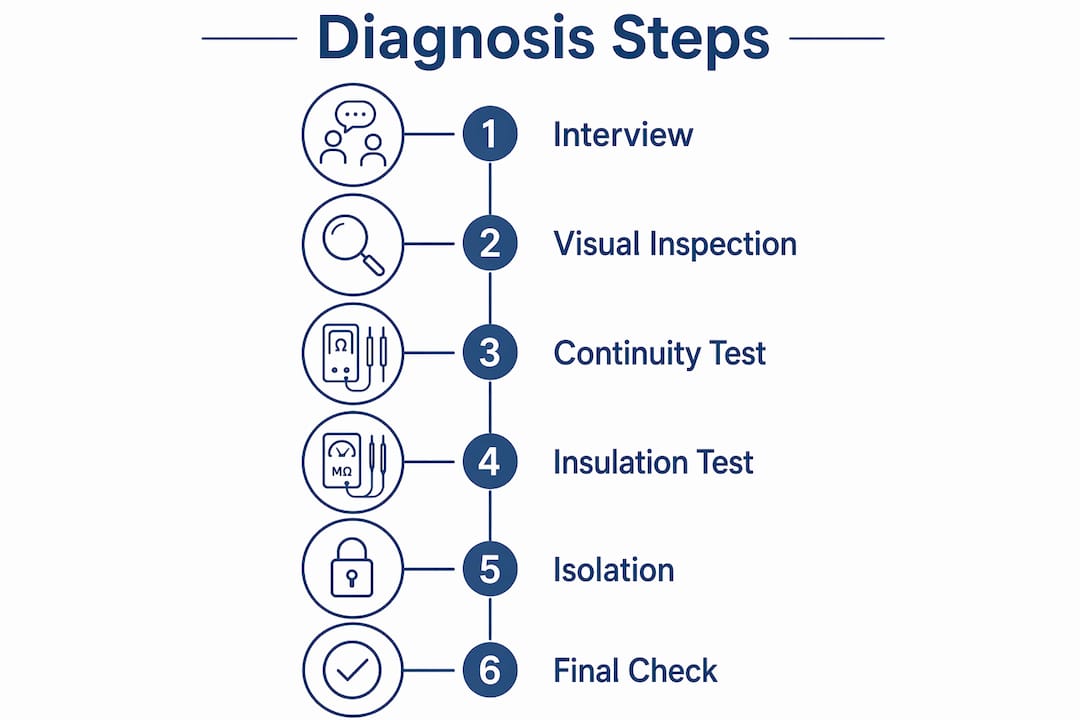
Electrical fault diagnosis is the process of systematically identifying the cause of a failure or hazard in a home’s wiring, circuits, or connected equipment. Understanding how electricians diagnose electrical faults gives you a clear picture of what to expect when a professional arrives, and why their process is far safer and more accurate than guessing. A trained electrician follows a 6-step systematic process: information gathering, visual inspection, circuit testing, fault isolation, root cause identification, and repair verification. Each step builds on the last, turning a confusing symptom into a confirmed fix.
How electricians diagnose electrical faults: the first steps
Before any test equipment comes out, an electrician talks to you. Experienced electricians interview the homeowner about the fault’s timeline and nature, because intermittent or triggered faults often reveal their causes only through conversation. A breaker that trips every time the dishwasher runs tells a very different story than one that trips randomly at 2 a.m.
The questions an electrician asks are deliberate. When did the problem start? Did anything change before it appeared, like a new appliance, recent rain, or construction nearby? Does the fault happen at a specific time of day or under a specific load? Your answers narrow the field of possible causes before a single test is run.
After the interview, the electrician performs a visual inspection. A visual inspection can reveal faults without any test equipment by spotting scorch marks, damaged cable sheathing, loose connections, or tripped protective devices. Scorch marks near an outlet, for example, point directly to arcing or overheating at that location. This phase alone resolves a surprising number of faults.
Common visual clues electricians look for include:
- Scorch marks or discoloration around outlets, switches, or the panel
- Melted or cracked cable insulation
- Water stains or corrosion near wiring or junction boxes
- Tripped circuit breakers or blown fuses
- Loose connections at terminals or junction boxes
Pro Tip: Before the electrician arrives, note exactly when the fault occurs and what was running at the time. That information cuts diagnosis time significantly and may reduce your service bill.
What electrical tests do electricians perform to isolate faults?
Once the visual phase is complete, the electrician moves to instrument testing. Standard diagnostic tests include continuity, voltage, resistance, current, insulation resistance, ground fault, and load testing. A digital multimeter covers most of these. A megohmmeter handles insulation resistance testing, which requires much higher test voltages than a standard multimeter can produce.
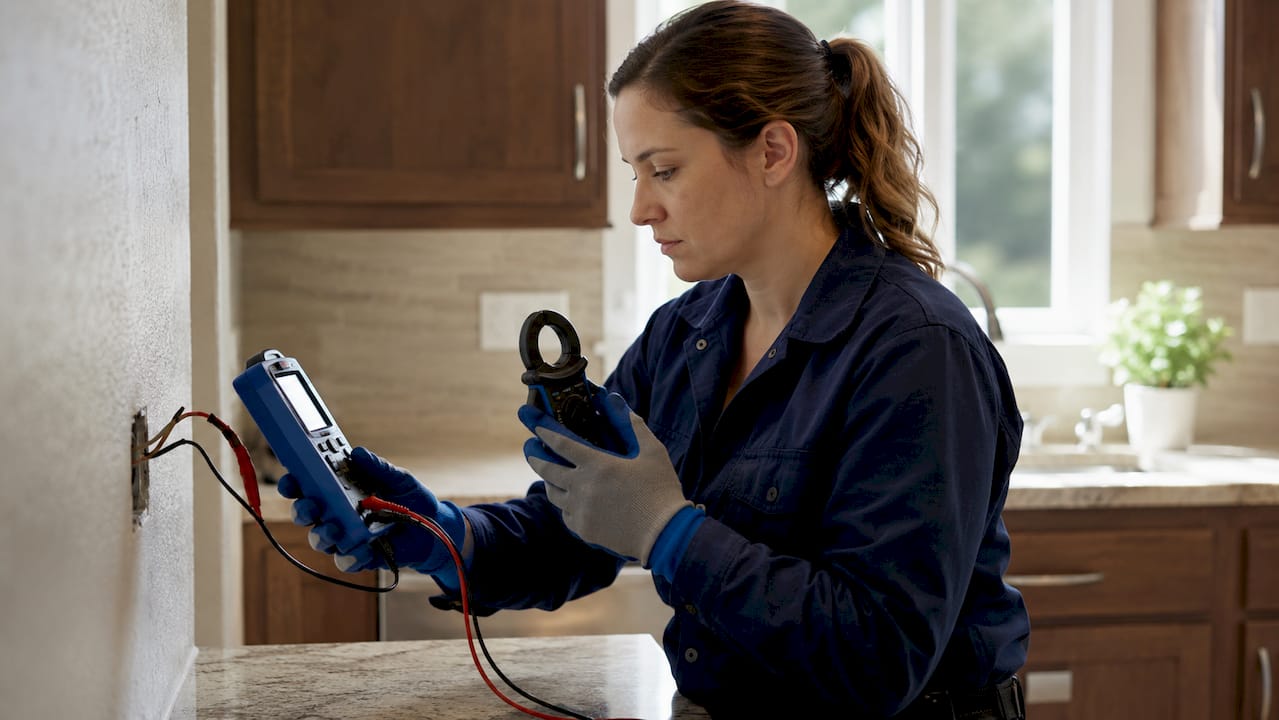
Each test answers a specific question about circuit health. Here is how the main tests work and what their results mean:
| Test | What it checks | Key threshold |
|---|---|---|
| Continuity | Unbroken path through a conductor | Below 0.5 ohms confirms healthy path |
| Insulation resistance | Integrity of wire insulation | Below 1 megohm indicates definite fault |
| Earth fault loop impedance | Effectiveness of the earth return path | Must meet BS 7671 limits for circuit type |
| RCD operation | Speed and sensitivity of residual current device | Must trip within 40 milliseconds at rated current |
| Polarity | Correct wiring of live, neutral, and earth | Any reversal is a code violation and safety risk |
The insulation resistance test deserves special attention. BS 7671, the UK wiring standard widely referenced in professional electrical practice, requires a minimum of 1 megohm. Healthy circuits measure in the hundreds of megohms. A reading of 1–2 megohms signals impending failure. A reading below 1 megohm confirms an active fault. That distinction matters because a circuit can appear to work normally while its insulation is quietly breaking down.
Electricians do not run every test on every circuit. They follow a logical sequence based on the symptoms. An RCD that trips immediately on reset points toward an earth leakage fault, so insulation resistance testing comes first. A dead circuit with no trip suggests a continuity problem, so the electrician starts there.
Pro Tip: Ask your electrician to explain what each test result means as they work. A good electrician will walk you through the findings in plain language, not just hand you a report.
The half-split method
The half-split method is a time-saving technique electricians use to locate faults in long circuits or cable runs. Instead of testing every point from one end, the electrician tests the midpoint of the circuit first. If the fault is present on one half, that half becomes the new search area, and the process repeats. A circuit that might require ten individual tests can be resolved in three or four using this approach. It is the electrical equivalent of a binary search.
How do electricians separate wiring faults from appliance faults?
Not every fault lives in the wiring. Appliances cause a large share of RCD trips and circuit overloads. Systematic isolation of appliance faults from fixed wiring allows electricians to keep diagnosis efficient and prevents unnecessary expense for homeowners.
The process works like this. The electrician isolates the affected circuit at the breaker panel, then unplugs every appliance on that circuit. If the circuit tests clean with all appliances removed, the fault is in a device, not the wiring. The electrician then plugs appliances back in one at a time until the fault reappears. The last device plugged in before the fault returns is the culprit.
This approach matters for cost. Replacing wiring in a wall is expensive. Replacing a faulty appliance or its plug is not. Confirming which category the fault falls into before any repair work begins saves you money and avoids unnecessary disruption to your home.
Common fault scenarios that benefit from systematic isolation include:
- Intermittent faults: A circuit that trips occasionally but not consistently. Isolation testing under load reveals whether a specific appliance triggers the fault.
- Overload faults: Too many devices drawing current on one circuit. Removing appliances one by one identifies which combination pushes the circuit past its rated capacity.
- Short circuit faults: A direct connection between live and neutral or earth. Isolation confirms whether the short is in a device or in the fixed wiring itself.
- Earth leakage faults: A small current escaping to earth through damaged insulation. Insulation resistance testing after isolation pinpoints the exact cable or device responsible.
Breaker locks and circuit labeling play a safety role here too. Before isolating any circuit, a licensed electrician locks out the breaker and labels it to prevent accidental re-energizing while work is in progress. This is a non-negotiable safety step, not an optional one.
What safety rules should homeowners follow during fault diagnosis?
Your role during electrical fault diagnosis is observer, not participant. Homeowners should limit themselves to external observations and never open accessory covers or use metal tools near wiring. The risks of doing otherwise are serious and immediate.
The most common mistake homeowners make is repeatedly resetting a tripping breaker. Repeatedly resetting a tripping breaker masks the root cause and risks overheating or component damage. A breaker trips for a reason. Forcing it back on without knowing why is like ignoring a smoke alarm by removing the battery.
Signs that require immediate professional intervention include:
- A burning smell from any outlet, switch, or panel
- Visible sparks or arcing at any point in the system
- An outlet or switch that is warm or hot to the touch
- Any sign of water near electrical components
- A breaker that trips immediately every time it is reset
Flickering lights or warm sockets, often dismissed as minor annoyances, frequently signal serious developing faults. A flickering light caused by a loose neutral connection can escalate to arcing and fire if left unaddressed. Treat these symptoms as early warnings, not background noise.
Electricians follow the prove-test-prove method for voltage measurement. This method requires confirming a tester works on a known live source, testing the suspect circuit, then confirming the tester still works afterward. Relying on a single non-contact voltage pen without this verification step is a recognized safety failure. Homeowners have no reliable way to replicate this process safely, which is exactly why professional diagnosis matters.
Pro Tip: Review the electrical safety tips for Grand Strand homeowners before any fault occurs. Knowing what to watch for puts you in a much better position to give an electrician accurate information when you call.
Gregbeverlyservices: expert fault diagnosis for Grand Strand homeowners
Gregbeverlyservices has served residential customers in the Grand Strand area for over 40 years. When a fault appears in your home, the team brings the full diagnostic process described here, from structured homeowner interviews to instrument testing and systematic circuit isolation, to every service call.

The residential electrical services at Gregbeverlyservices cover fault diagnosis, testing against current safety standards, and verified repairs that meet local code requirements. Every technician communicates findings in plain language so you understand exactly what was wrong and what was done to fix it. For homeowners who want a reliable, experienced team that treats safety as the starting point rather than an afterthought, Gregbeverlyservices is the call to make.
Key takeaways
Electricians diagnose electrical faults through a structured six-step process that moves from symptom history and visual inspection through instrument testing and systematic isolation to confirmed repair.
| Point | Details |
|---|---|
| Six-step process | Diagnosis follows a fixed sequence: gather information, inspect visually, test circuits, isolate the fault, find the root cause, verify the repair. |
| Insulation resistance threshold | Readings below 1 megohm confirm an active fault; healthy circuits measure in the hundreds of megohms per BS 7671. |
| Half-split method | Testing circuit midpoints first cuts the number of required tests from ten or more down to three or four. |
| Appliance vs. wiring isolation | Unplugging all devices and testing the bare circuit confirms whether the fault is in an appliance or the fixed wiring. |
| Homeowner safety rule | Never reset a tripping breaker repeatedly. Call a professional and note when and how the fault occurs instead. |
FAQ
What does an electrician do first when diagnosing a fault?
An electrician starts by interviewing the homeowner about when the fault began, what triggers it, and what changed before it appeared. This conversation guides every test that follows.
How do electricians test for insulation faults?
Electricians use a megohmmeter to measure insulation resistance. A reading below 1 megohm confirms a fault; healthy circuits read in the hundreds of megohms.
Can a homeowner safely help with electrical fault diagnosis?
Yes, but only by observing and recording symptoms. Homeowners should never open outlet covers, use metal tools near wiring, or reset a tripping breaker repeatedly before a professional arrives.
What causes most residential electrical faults?
Common fault symptoms include RCD trips from earth leakage, MCB trips from overloads or short circuits, flickering lights from loose neutrals, and warm outlets from loose wiring. Faulty appliances cause a large share of these events.
How long does electrical fault diagnosis take?
Diagnosis time varies with fault complexity. A straightforward appliance fault identified through isolation testing may take under an hour. An intermittent wiring fault requiring load testing and the half-split method can take several hours.