
An electrical service contract is a legal agreement that defines the scope, terms, and responsibilities for ongoing electrical maintenance, inspections, and emergency repairs between a property owner and an electrical service provider. This formal arrangement differs fundamentally from a one-time electrical project contract. Where a single project ends at completion, a service agreement covers routine maintenance, safety inspections, and priority emergency repairs on a continuing basis. For homeowners and property managers in the Grand Strand area, understanding the role of electrical service contracts explained in plain terms is the first step toward safer, more predictable property management.
What does an electrical service contract actually cover?
Electrical service agreements cover ongoing maintenance, safety inspections, and priority emergency repairs. That scope is what separates them from one-time project contracts focused on a single installation or repair job. A well-written agreement spells out exactly what the contractor will do, when they will do it, and what happens when something goes wrong outside of scheduled visits.
The core components you should expect in any electrical service agreement include:
- Scope of work: Routine inspections, preventive maintenance visits, emergency callouts, and priority scheduling during outages or faults.
- Payment terms: Fixed monthly or annual fees, billing cycles, and any additional charges for parts or after-hours labor.
- Cancellation policy: Standard cancellation policies allow 30 days written notice. The Federal Cooling-Off Rule also gives you 3 business days to cancel any home solicitation sale over $25.
- Liability limitations: Liability caps are common clauses that limit a contractor’s financial exposure to the amount you paid in the prior 12 months. This protects both parties from lawsuits disproportionate to the contract value.
- Warranty terms: Repairs and diagnostics typically carry a minimum 90-day warranty under proactive service models.
- Documentation requirements: Service reports, inspection logs, and thermographic scan records needed for insurance and regulatory compliance.
- Parts logistics: Whether the contractor stocks critical components on-site, or whether you are responsible for storing certain spare parts to enable rapid emergency repairs.
Pro Tip: Read the liability cap clause carefully before signing. If the cap is set at the prior 12 months of fees, a low-cost contract may leave you underprotected on a high-value property.
The spare-parts question is one most property owners overlook. Not all contractors stock critical components on-site, which means a missing part can delay an emergency repair by days. Clarify this upfront and get the answer in writing.

How do electrical service contracts benefit homeowners and property managers?
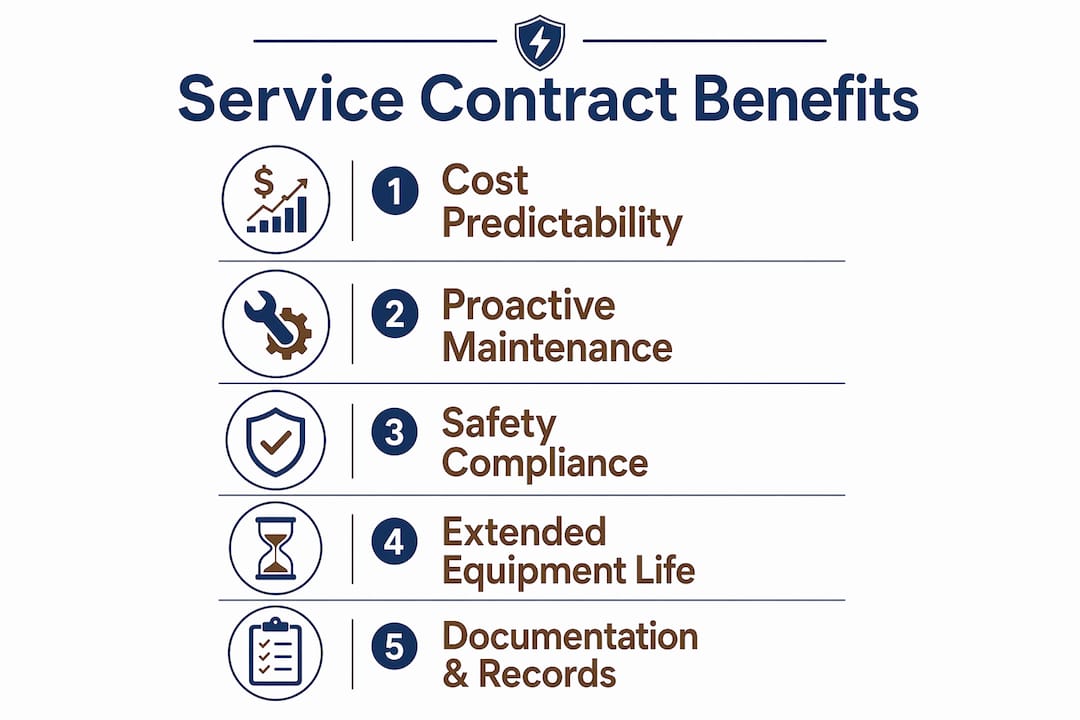
The financial and safety advantages of a service agreement are concrete, not theoretical. The benefits fall into four clear categories.
-
Cost control. Proactive service agreements charge routine maintenance at standard rates rather than expensive 24/7 emergency premiums. Emergency call rates can run significantly higher than scheduled maintenance visits. Locking in a flat service fee removes that unpredictability from your budget.
-
Early fault detection. Regular inspections catch problems before they become failures. Thermal anomalies, load imbalances, and degrading components are early warning signs found during routine visits. A loose electrical termination can overheat to 80°C and cause main breaker failure. Catching it during a scheduled inspection costs far less than replacing a breaker panel after a failure.
-
Extended warranty coverage. Repairs made under a service agreement typically carry at least a 90-day warranty. That coverage gives you recourse if a fix does not hold, without paying for a second service call.
-
Documentation for insurance and compliance. Insurers and fire marshals increasingly require proof of proactive maintenance. Service reports, thermographic scans, and torque logs create a paper trail that supports insurance audits and regulatory inspections.
Pro Tip: Ask your contractor to provide a written summary after every visit, not just a sign-off sheet. That summary becomes your evidence file for insurance renewals and fire safety audits.
The shift from reactive to proactive electrical management is the single biggest operational advantage a service contract delivers. Property managers who run on a break-fix model spend more money, face more downtime, and carry more liability than those on scheduled maintenance programs. A service agreement formalizes the proactive approach and holds both parties accountable to it.
How do service contracts support safety and insurance compliance?
Electrical maintenance contracts carry real legal and regulatory weight. Aligning your contract with recognized standards is not optional if you want full insurance and compliance coverage.
Modern electrical maintenance contracts should align with NFPA 70B and ANSI/NETA MTS standards. NFPA 70B sets recommended practices for electrical equipment maintenance. ANSI/NETA MTS defines acceptance and maintenance testing specifications. Together, they form the baseline that insurance underwriters and fire marshals use when evaluating a property’s electrical safety record.
Key compliance areas a well-structured contract addresses:
- NFPA 70E workplace safety: Covers electrical safety in the workplace, including arc flash hazard analysis and personal protective equipment requirements for anyone working on energized systems.
- Fire safety inspections: Documented maintenance histories support fire marshal reviews and reduce the risk of citation or increased premiums.
- Insurance underwriting: Documented maintenance histories like thermographic scans and torque logs are required proof for insurance underwriting and fire marshal compliance. Insurers increasingly require this evidence before renewing commercial property policies.
- Liability exposure reduction: A contract that meets NFPA 70B and ANSI/NETA MTS standards gives you a documented defense if a fault leads to a claim.
The risks of non-compliance are direct. A property without documented maintenance records can face denied insurance claims after an electrical fire. A commercial property manager without NFPA 70E-aligned procedures faces regulatory fines and personal liability exposure. A service contract that references these standards by name closes those gaps.
| Compliance standard | What it covers | Why it matters for your contract |
|---|---|---|
| NFPA 70B | Electrical equipment maintenance practices | Sets inspection frequency and documentation requirements |
| ANSI/NETA MTS | Acceptance and maintenance testing specs | Defines testing methods insurers and fire marshals recognize |
| NFPA 70E | Electrical workplace safety | Covers arc flash analysis and energized work procedures |
| Federal Cooling-Off Rule | Home solicitation sales cancellation rights | Gives you 3 business days to cancel contracts over $25 |
For property managers overseeing commercial electrical maintenance, aligning contracts with these standards is the difference between a defensible maintenance record and a liability gap.
How to choose and manage an electrical service contract effectively
Choosing the right contract starts with matching the agreement’s scope to your property’s actual needs. A single-family home has different inspection requirements than a multi-unit rental property or a commercial building with high electrical loads.
Work through these evaluation points before signing:
- Inspection frequency and type: Confirm how often the contractor will visit and what each visit includes. Annual inspections suit low-demand residential properties. Quarterly visits are standard for commercial properties with heavy equipment loads.
- Documented deliverables: Every inspection should produce a written report. Verbal updates are not sufficient for insurance or compliance purposes.
- Contractor licensing and reputation: Verify the contractor holds a current state electrical license and carries liability insurance. Check references from properties similar to yours.
- Parts stocking and logistics: Ask directly whether the contractor carries common replacement parts on their service vehicles. If not, clarify who stores critical spares and how that affects emergency response time.
- Cancellation terms: Know your exit rights before you sign. Standard agreements require 30 days written notice. Contracts signed at your home fall under the Federal Cooling-Off Rule’s 3-business-day cancellation window.
- Contract duration: Annual contracts give you a natural review point. Multi-year agreements may offer lower rates but reduce your flexibility if service quality drops.
Pro Tip: Request a sample service report from the contractor before signing. If they cannot produce one, their documentation practices are likely inadequate for insurance or compliance purposes.
Tracking service reports over time gives you a living record of your property’s electrical health. That record supports budget planning, insurance renewals, and resale disclosures. Property managers who treat service reports as operational data, not just paperwork, get the most value from their agreements. For a detailed look at what inspections should cover, the electrical safety checklist from Gregbeverlyservices is a practical reference.
Gregbeverlyservices: electrical service contracts built for the Grand Strand
Gregbeverlyservices brings over 40 years of electrical experience to residential and commercial properties across the Grand Strand area. The team builds service agreements around your property’s specific needs, not a generic template.

Whether you need scheduled maintenance for your home’s electrical system, generator maintenance under a long-term agreement, or EV charger servicing as part of a broader contract, Gregbeverlyservices structures each agreement with clear scope, transparent pricing, and documentation that satisfies insurance and compliance requirements. Property managers can pair commercial electrical services with a maintenance contract that aligns with NFPA 70B standards. Homeowners can start with residential electrical services and build a maintenance schedule that fits their budget and safety goals. Contact Gregbeverlyservices to get a contract proposal tailored to your property.
Key takeaways
A well-structured electrical service contract shifts property management from reactive repairs to scheduled, documented maintenance that controls costs, reduces liability, and satisfies insurance requirements.
| Point | Details |
|---|---|
| Contracts differ from project work | Service agreements cover ongoing maintenance and inspections, not single jobs. |
| Know your cancellation rights | Standard agreements require 30 days notice; home solicitation contracts allow 3 business days under federal law. |
| Standards define compliance | Contracts aligned with NFPA 70B and ANSI/NETA MTS satisfy insurance underwriters and fire marshals. |
| Documentation is non-negotiable | Thermographic scans and torque logs are required proof for insurance audits and regulatory reviews. |
| Parts logistics affect response time | Clarify whether your contractor stocks critical components before an emergency occurs. |
FAQ
What is an electrical service contract?
An electrical service contract is a formal agreement between a property owner and an electrical contractor that defines the scope, schedule, and terms for ongoing maintenance, inspections, and emergency repairs. It differs from a one-time project contract because it covers recurring services over a set period.
What are the main benefits of electrical service contracts?
The main benefits include predictable maintenance costs at standard rates instead of emergency premiums, early fault detection through regular inspections, extended repair warranties, and documented maintenance records that support insurance and compliance requirements.
How do electrical service agreements support insurance compliance?
Insurers and fire marshals require documented proof of proactive maintenance, including thermographic scans and torque logs. Contracts aligned with NFPA 70B and ANSI/NETA MTS standards produce the records that satisfy those requirements.
Can I cancel an electrical service contract?
Standard contracts require 30 days written notice to cancel. If you signed the contract at your home through a sales visit, the Federal Cooling-Off Rule gives you 3 business days to cancel any agreement over $25 at no penalty.
How often should electrical inspections occur under a service contract?
Inspection frequency depends on property type. Annual inspections suit most residential properties. Commercial properties with heavy electrical loads typically require quarterly visits to meet NFPA 70B maintenance recommendations.