
Types of commercial property electrical upgrades include service entrance expansions, panel replacements, sub-panel additions, LED lighting retrofits, surge protection devices, EV charging infrastructure, and backup power systems. Each upgrade category addresses a specific gap in your building’s electrical capacity, safety, or compliance standing. Outdated panels deter tenants and limit leasing potential, making electrical improvements a direct investment in property value. Gregbeverlyservices has spent over 40 years helping Grand Strand property owners plan and execute these upgrades with full code compliance and zero guesswork.
1. Types of commercial property electrical upgrades: an overview
Commercial electrical system improvements fall into seven core categories. Service upgrades require permits and utility coordination, while tenant improvement work often carries separate permits. Understanding which category applies to your building determines your timeline, budget, and the sequence of work. A licensed electrician should assess your current load before any upgrade begins, especially if your main panel is 20–25 years old or breakers trip regularly.
2. Service entrance upgrades and main panel replacements
A service entrance upgrade increases the amperage delivered from the utility to your building, typically moving from 100A to 200A or higher. A main panel replacement swaps out the breaker box itself, often because the existing unit is obsolete or undersized. Obsolete panels like Federal Pacific or Zinsco create real safety risks and fail modern load demands. Replacing them removes a liability and opens capacity for new equipment, EV charging stations, and HVAC systems.
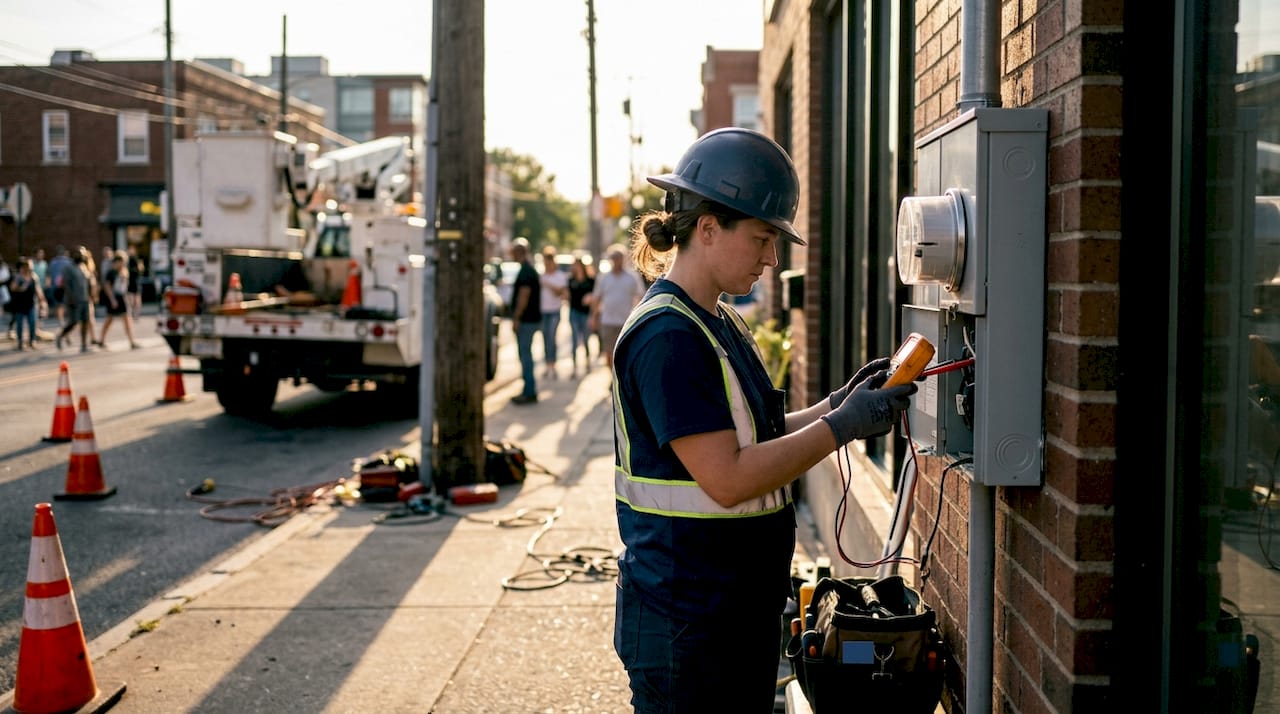
The project requires utility coordination, a permit, and a planned power outage. Standard replacements cause 4–8 hours of downtime; complex switchgear replacements run longer. Scheduling off-hours work reduces disruption to tenants and operations. Utility service coordination can also delay the project, so equipment delivery and tenant moves must wait for confirmed service availability.
Grounding and bonding verification are frequently skipped during panel upgrades. Ignoring these requirements causes inspection failures and creates shock hazards. Every panel upgrade must address the full distribution system, not just amperage, to meet NEC compliance.
Pro Tip: Size your new panel for 3–5 years of projected growth, not just current demand. Adding capacity now costs far less than a second upgrade later.
| Panel type | Typical upgrade scope |
|---|---|
| Federal Pacific / Zinsco | Full replacement required; no repair option |
| Undersized 100A panel | Upgrade to 200A or 400A service |
| Aging 200A panel (25+ years) | Replace breakers and verify grounding |
| Commercial switchgear | Full replacement with off-hours scheduling |
3. Sub-panel additions and distribution panel upgrades
A sub-panel is a secondary breaker box fed from the main panel. It adds circuits to a specific area, such as a tenant suite, a server room, or a dedicated equipment zone, without requiring a full service upgrade. Load calculations determine whether a full service upgrade is necessary or whether sub-panel additions and distribution changes resolve the capacity gap at lower cost. This distinction saves property owners significant money when the main service has headroom remaining.
Sub-panels work well for isolating sensitive equipment, balancing loads across a building, and supporting EV charging in a parking structure without touching the main switchgear. A licensed electrician runs a feeder from the main panel to the new sub-panel location, sizes the breaker correctly, and verifies that the main panel can support the added load. 3-phase load balancing through sub-panel additions often resolves capacity issues at a fraction of full service upgrade costs.
When sub-panels work vs. when they do not:
- Sub-panels work when the main service has unused capacity and you need circuits in a remote area of the building
- Sub-panels work when a tenant needs dedicated power without affecting other units
- Sub-panels work for adding EV charging in a parking area fed from an existing 400A service
- A full service upgrade is necessary when the utility feed itself is undersized for total building demand
- A full service upgrade is necessary when the main panel is obsolete or physically damaged
Mini example: A retail center with a 400A main service wanted to add four Level 2 EV chargers in its parking lot. A load calculation showed 80A of available capacity. The electrician installed a 100A sub-panel in the parking structure, fed from the main panel, and wired four dedicated 240V circuits. No utility coordination was needed, and the project finished in two days.
4. Lighting upgrades and energy efficiency
LED lighting retrofits replace fluorescent and HID fixtures with LED drivers and lamps. The result is lower energy consumption, longer fixture life, and better light quality for tenants and employees. Old fluorescent or HID fixtures often need rewiring or circuit changes to work with LED drivers, so a lighting upgrade is not always a simple swap. Your electrician should evaluate circuit loads before specifying new fixtures.
Smart lighting controls add another layer of savings. Occupancy sensors cut power when spaces are empty. Daylight harvesting dims fixtures near windows based on natural light levels. Automated scheduling turns off lights in common areas after business hours. These controls require low-voltage wiring and sometimes a dedicated control panel, which ties the lighting upgrade back into your broader electrical system improvement plan.
Utility rebate programs from providers like Duke Energy or Dominion Energy often offset the cost of LED retrofits and smart controls. Check with your utility before finalizing fixture specs, since rebate eligibility depends on product certifications and installation documentation.
Pro Tip: Schedule your lighting upgrade at the same time as a panel evaluation. LED retrofits sometimes reduce total load enough to defer a full service upgrade by several years.
5. Surge protection and backup power systems
Panel-level surge protective devices, known as SPDs, protect your entire electrical system from voltage spikes caused by lightning, utility switching, or large motor startups. Panel SPD installation requires a licensed contractor and delivers far better protection than outlet strips, which only guard individual devices. Many commercial insurance policies and utility incentive programs now require or reward SPD installation at the panel level. Documentation of the installation supports insurance claims after a surge event.
Backup power systems keep operations running when the grid fails. Commercial generators sized for your critical loads, combined with automatic transfer switches, restore power within seconds of an outage. Uninterruptible power supply units, called UPS systems, protect servers and sensitive equipment from even brief interruptions. Backup generators integrated with panel upgrades require proper circuit coordination and compliance checks to function correctly.
Key considerations for surge protection and backup power:
- Panel SPDs must match the service voltage and amperage of your main panel
- Generator sizing depends on which loads you designate as critical, not total building load
- Automatic transfer switches must be rated for your service amperage
- UPS systems require dedicated circuits and battery replacement schedules
- Both upgrades benefit from being planned during a panel replacement to reduce labor costs
6. EV charging infrastructure installation
EV charging stations require 240V dedicated circuits and meaningful electrical capacity. Poor capacity planning leads to costly second upgrades when demand grows beyond what the original installation can support. Load modeling before installation determines whether your existing service can absorb the added demand or whether a service entrance upgrade must come first. Skipping this step is the single most common mistake in commercial EV projects.
Level 2 chargers draw between 30A and 80A each, depending on the unit. A parking lot with 10 chargers can add 300A or more to your building’s total load. Smart chargers with load management software reduce peak demand by staggering charging sessions, which can keep you within your existing service capacity. Utility coordination and permitting are required for any service upgrade connected to EV infrastructure.
EV charging upgrades also serve as a tenant attraction strategy. Outdated properties without EV infrastructure lose ground to competing buildings that offer charging as a standard amenity. Emerging local and state regulations are beginning to require EV readiness in new commercial construction, and retrofitting later costs more than planning now.
Pro Tip: Consult your electrician before signing an EV charger contract. The charger vendor will specify electrical requirements, but only a licensed electrician can confirm whether your service can handle them.
| EV infrastructure option | Electrical requirement | Best use case |
|---|---|---|
| Single Level 2 charger | 240V, 40–50A dedicated circuit | Small retail or office with low demand |
| Multi-station installation | Sub-panel or service upgrade | Larger parking lots, multi-tenant buildings |
| Smart chargers with load management | Existing service with software control | Properties near service capacity limits |
Key takeaways
The most effective commercial electrical upgrades combine capacity increases, safety corrections, and energy efficiency improvements planned together rather than executed as separate reactive repairs.
| Point | Details |
|---|---|
| Start with a load calculation | A load calculation determines whether a sub-panel or a full service upgrade is the right scope. |
| Replace obsolete panels first | Federal Pacific and Zinsco panels require full replacement before adding any new loads. |
| Plan EV infrastructure early | Load modeling before charger installation prevents costly repeat upgrades as demand grows. |
| Add panel-level surge protection | SPDs protect the entire system and support insurance documentation after surge events. |
| Treat upgrades as investments | Electrical improvements raise property value and attract tenants who require modern infrastructure. |
What I’ve learned about planning commercial electrical upgrades
Most property owners call an electrician after something fails. A breaker trips repeatedly, a tenant complains about voltage drops, or a new piece of equipment simply will not run. That reactive approach almost always costs more than a planned upgrade would have. The real opportunity is in the assessment that happens before anything breaks.
The biggest mistake I see is treating each upgrade as an isolated project. A property owner installs EV chargers, then discovers six months later that the main panel cannot support a new HVAC unit. A lighting retrofit gets completed without anyone checking whether the panel can handle the new LED driver loads cleanly. These are not independent decisions. Every upgrade affects the others, and a qualified electrician who runs a full load analysis at the start saves you from paying for the same work twice.
Grounding and bonding are the other area that gets skipped. They are invisible, they do not show up on a tenant’s punch list, and they do not generate complaints until there is an inspection failure or a safety incident. Every panel upgrade should include a full grounding verification. It is not optional under the NEC, and it is not expensive relative to the rest of the project.
The property owners who get the best outcomes treat their electrical system the way they treat their roof. They schedule assessments, they plan ahead, and they upgrade before failure forces their hand. That mindset turns electrical work from a cost center into a genuine asset.
— SEO
Work with Gregbeverlyservices on your next electrical upgrade
Gregbeverlyservices brings over 40 years of commercial electrical experience to the Grand Strand area. Whether you need a panel replacement, EV charger installation, or a full commercial electrical service assessment, the team handles permitting, utility coordination, and code compliance from start to finish.
Gregbeverlyservices also installs and maintains commercial generators and EV charging stations for properties planning ahead for tenant demands and grid reliability. Contact Gregbeverlyservices to schedule a load analysis and get a clear picture of what your property needs now and over the next five years.
FAQ
What triggers the need for a commercial electrical upgrade?
Panels over 20–25 years old, frequent breaker trips, obsolete equipment like Federal Pacific or Zinsco panels, and new high-demand loads like EV chargers all signal that an upgrade is due. A professional load assessment confirms the scope.
Can a sub-panel replace a full service upgrade?
A sub-panel works when the main service has unused capacity and you need circuits in a specific area. A full service upgrade is necessary when the utility feed itself cannot support total building demand.
How long does a commercial panel replacement take?
Standard panel replacements cause 4–8 hours of downtime. Complex switchgear replacements take longer and typically require off-hours scheduling to minimize tenant disruption.
Do LED lighting upgrades require electrical panel changes?
Not always, but old fluorescent or HID circuits often need rewiring to work with LED drivers. An electrician should evaluate circuit loads before specifying new fixtures to confirm compatibility.
What is the best first step before any commercial electrical upgrade?
A licensed electrician should perform a full load calculation before any upgrade begins. Load calculations determine the correct upgrade scope and prevent unnecessary or undersized work.