
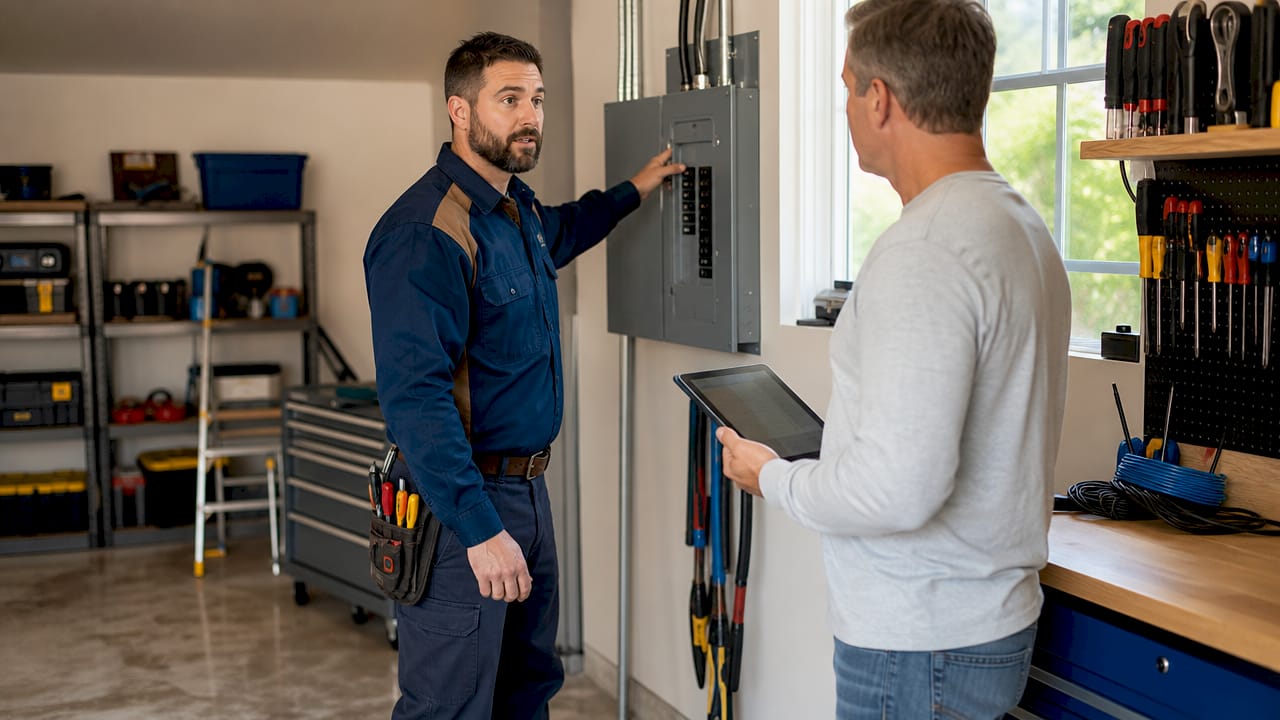
An electrical panel upgrade is the process of replacing or enhancing your home’s main electrical panel to increase capacity and meet modern safety standards. What electrical panel upgrade involves goes beyond swapping a box. It includes evaluating your existing system, replacing breakers, updating grounding and bonding, pulling permits, coordinating with your utility company, and passing a formal inspection. For homeowners adding EV chargers, solar panels, or whole-home generators, understanding this process prevents budget surprises and keeps your project on schedule.
What are the core components and steps in an electrical panel upgrade?
An electrical panel upgrade replaces or enhances the main panel to increase capacity, improve safety, and meet current code requirements. The process follows a defined sequence, and skipping any step creates safety risks or inspection failures.
Here is how a typical upgrade unfolds from start to finish:
- Load evaluation. A licensed electrician calculates your current and projected electrical loads, including appliances, HVAC, and any new additions like an EV charger or generator.
- Permit application. Your electrician submits a permit application to the local authority having jurisdiction (AHJ). Permits typically cost between $100 and $500 and are non-negotiable for legal work.
- Utility coordination. The utility company disconnects power at the meter before work begins. This step requires scheduling in advance and can add a day or two to the project timeline.
- Panel removal and installation. The old enclosure is removed and the new panel assembly is installed. This includes the main disconnect, branch circuit breakers, and bus bars.
- Grounding and bonding updates. Per NEC Article 250, the main bonding jumper and grounding electrode system are verified and upgraded as needed. Proper grounding prevents shock hazards and is a primary inspection focus.
- Service entrance work. If the meter base or service entrance cables are undersized for the new amperage, those are replaced as part of this phase.
- Circuit labeling and cleanup. Every breaker is clearly labeled before the inspector arrives. This step is more critical than most homeowners expect.
- Inspection and power restoration. The inspector reviews the work before the utility reconnects power. A passed inspection is required before the panel goes live.
Most residential upgrades are completed in one workday, though utility scheduling can extend the overall timeline to two or three days.
Pro Tip: Clear the area around your panel before the electrician arrives. NEC 110.26 requires 3 feet of clear depth, 30 inches of width, and up to 6.5 feet of headroom in front of the panel. Blocked access is one of the most common causes of failed inspections, even when the hardware installation is perfect.
How do different types of panel upgrades vary in scope?
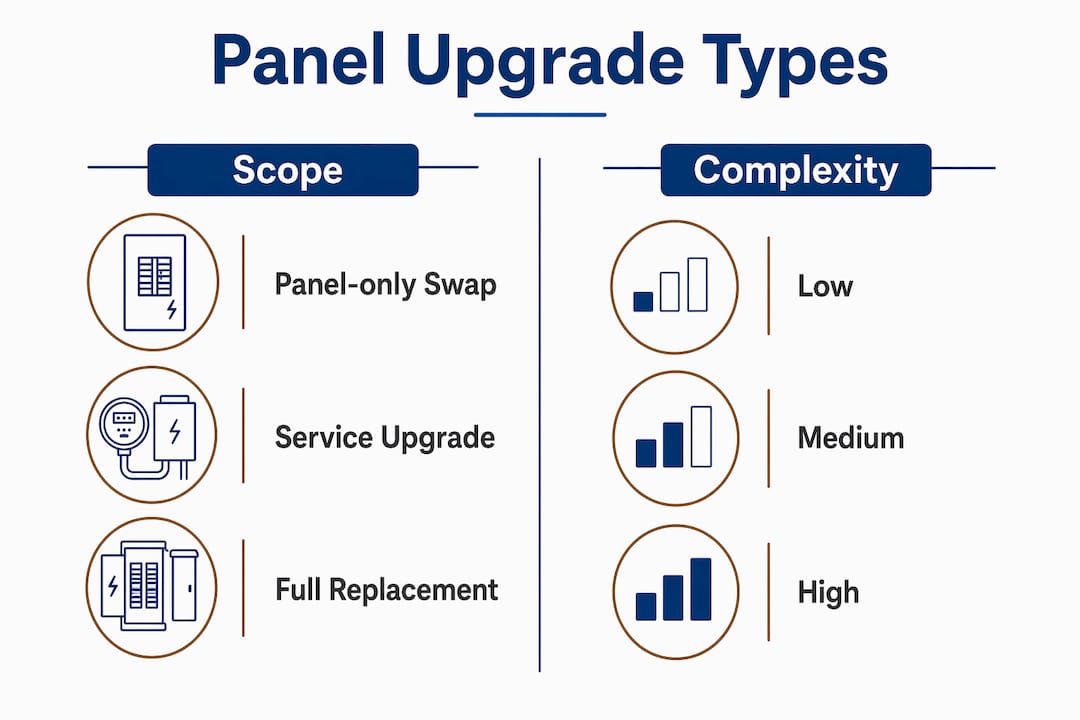
Not every panel upgrade is the same project. Scope varies significantly depending on whether you need a panel-only swap, a service upgrade, or a full service replacement. Misidentifying the scope is the most common reason homeowners receive a higher-than-expected final bill.
Here is a breakdown of the three primary upgrade types:
| Upgrade type | What it includes | Typical complexity | Estimated cost range |
|---|---|---|---|
| Panel-only swap | New panel enclosure and breakers, same amperage | Low | $1,000 to $1,800 |
| Service upgrade | New panel plus upgraded service entrance cables and meter base | Medium | $1,300 to $3,000 |
| Full service replacement | All of the above plus weatherhead, grounding electrode, and utility coordination | High | $2,000 to $4,500+ |
A common upgrade path moves a home from 100-amp to 200-amp service. Larger properties or those adding solar and EV infrastructure sometimes require 400-amp service, which always qualifies as a full service replacement. The meter base, service conductors, and weatherhead all need to match the new amperage rating.
Scope creep is common because many projects start as panel-only swaps but expand once the electrician discovers that the existing meter base or service entrance conductors cannot support the higher capacity. Budget for one tier above your initial estimate to avoid mid-project surprises.
Pro Tip: Ask your electrician to evaluate the meter base and service entrance cables before finalizing your quote. Discovering these need replacement after work has started adds cost and delays utility coordination.
What permits, inspections, and code requirements apply?
Permits and inspections are not optional formalities. They are the legal framework that protects you, your family, and your property value. Unpermitted electrical work can void homeowner’s insurance, complicate home sales, and create genuine fire hazards.
Key regulatory requirements for panel upgrades include:
- Permit fees. Nearly all panel upgrades require permits costing $100 to $500, with inspections scheduled before power is restored. This cost is typically included in a licensed electrician’s quote.
- NEC 110.26 clearances. The National Electrical Code mandates specific working space around panels. Three feet of clear depth, 30 inches of width, and adequate headroom are required. Storage in front of a panel fails inspection regardless of how well the hardware is installed.
- NEC Article 250 grounding. The main bonding jumper, grounding electrode conductors, and grounding electrode system must all be verified and brought up to current code during the upgrade.
- AFCI and GFCI breakers. Modern NEC editions require Arc Fault Circuit Interrupter (AFCI) breakers in bedrooms, living areas, and other spaces, and Ground Fault Circuit Interrupter (GFCI) protection in kitchens, bathrooms, and outdoor circuits. A panel upgrade is the right time to bring these up to standard.
- Utility coordination. Coordinating with your utility for disconnect and reconnect at the meter is a required step. Your electrician handles this scheduling, but it affects your project timeline.
- Inspection before power restore. The inspector must approve the work before the utility reconnects power. Inspectors review circuit labeling, termination quality, clearances, and grounding documentation.
Skipping permits creates a paper trail problem that surfaces during home sales. Buyers’ inspectors and title companies routinely flag unpermitted electrical work, and remediation after the fact costs significantly more than doing it right the first time.
How much does an electrical panel upgrade typically cost?
Residential panel upgrades cost between $1,300 and $3,000 for a standard 200-amp service, and between $2,000 and $4,500 or more for larger amperage upgrades. That range reflects real variation in project scope, not contractor markup. Understanding what drives cost helps you evaluate quotes accurately.
The main factors that affect your final price:
- Amperage increase. Moving from 100A to 200A costs less than moving from 200A to 400A. Larger service requires heavier conductors, a larger meter base, and more utility coordination.
- Scope tier. A panel-only swap costs less than a full service replacement. See the comparison table above for ranges by tier.
- Accessibility. Panels in tight crawl spaces, finished basements, or locations requiring conduit runs add labor hours.
- Wiring condition. If the existing branch circuit wiring is aluminum or in poor condition, additional remediation work may be required.
- Added loads. Installing an EV charger or whole-home generator alongside the panel upgrade adds equipment and labor costs but is more efficient than scheduling them separately.
- Permit and inspection fees. These are typically $100 to $500 and are often included in the electrician’s total quote. Confirm this before signing.
Pro Tip: Get three quotes, but do not evaluate them on price alone. Ask each contractor to specify exactly which scope tier their quote covers. A $1,400 quote for a panel-only swap and a $2,800 quote for a full service replacement are not comparable numbers.
What signs indicate your electrical panel needs an upgrade?
Recognizing the signs your electrical panel needs an upgrade early prevents more expensive emergency repairs and reduces fire risk. Outdated electrical systems are identified through a combination of physical symptoms, age, and increased power demand.
Watch for these warning signs:
- Frequent breaker trips. Breakers that trip regularly under normal household loads signal that your panel is undersized for current demand.
- Flickering or dimming lights. Lights that dim when appliances start indicate voltage fluctuations caused by an overloaded or failing panel.
- Burning smell or scorch marks. Any burning odor near the panel or visible scorch marks on breakers or wiring requires immediate professional attention.
- Fuse box still in service. Homes with original fuse boxes are operating on technology that predates modern safety standards. Fuse boxes cannot accommodate AFCI or GFCI protection and are a significant insurance and safety liability.
- Panel age over 25 to 30 years. Panels from manufacturers like Federal Pacific Electric (Stab-Lok) and Zinsco have documented safety issues and are flagged by home inspectors and insurance companies.
- New high-draw appliances. Adding an EV charger, central air conditioning, a hot tub, or a home workshop often pushes a 100-amp panel past its capacity.
- Home renovation or addition. Any project that adds square footage or new circuits requires a load calculation to confirm the existing panel can handle the increase.
If you recognize more than one of these signs, a consultation with a licensed electrician is the right next step. You can review signs specific to Myrtle Beach homes for localized guidance on what inspectors and utilities in the Grand Strand area typically flag.
Key takeaways
A successful electrical panel upgrade requires evaluating your load needs, matching the right scope tier to your project, pulling permits, meeting NEC clearance and grounding standards, and passing inspection before power is restored.
| Point | Details |
|---|---|
| Scope determines cost | Panel-only swaps, service upgrades, and full replacements carry different price ranges and timelines. |
| Permits are mandatory | Permits cost $100 to $500 and protect your insurance coverage and home resale value. |
| NEC clearances matter | Three feet of clear space in front of your panel is required by NEC 110.26 and affects inspection outcomes. |
| Grounding must be verified | NEC Article 250 requires bonding jumper and grounding electrode checks during every panel upgrade. |
| Warning signs are actionable | Frequent trips, flickering lights, and panel age over 25 years are reliable indicators that an upgrade is overdue. |
What I’ve learned from watching homeowners navigate panel upgrades
Most homeowners come into a panel upgrade thinking it is a straightforward swap. Pull the old box, install the new one, done. What surprises them most is how much of the project happens outside the panel itself. Utility scheduling, permit timelines, grounding electrode work, and service entrance evaluation routinely add scope that was never part of the original conversation.
The single biggest mistake I see is homeowners selecting a contractor based on the lowest quote without confirming what that quote actually covers. A quote that excludes utility coordination, permit fees, or meter base replacement is not a bargain. It is an incomplete scope that will expand mid-project at the worst possible time.
Clear labeling is another area that gets underestimated. Inspectors scrutinize circuit labeling and termination quality as closely as they review hardware. A panel with unlabeled breakers or a cluttered workspace can fail inspection even when every component is correctly installed. That means a re-inspection fee, another utility coordination call, and a delay before your power comes back on.
My honest advice: work with a licensed electrician who handles the permit application, utility coordination, and inspection scheduling as part of the job. That is not a premium service. That is the baseline for work done correctly. If a contractor asks you to pull your own permit or coordinate with the utility yourself, find someone else.
— SEO
How Gregbeverlyservices can handle your panel upgrade from start to finish
Gregbeverlyservices has served residential and commercial customers across the Grand Strand for over 40 years, and panel upgrades are a core part of that work. The team handles permit applications, utility coordination, NEC compliance, and inspection scheduling so you are not managing those moving parts yourself.
Whether your project is a straightforward residential panel upgrade or a full service replacement tied to a new EV charger installation or generator setup, Gregbeverlyservices brings the experience to scope it correctly from the first visit. The team provides transparent quotes that specify exactly what is included, so you know what you are paying for before work begins. Contact Gregbeverlyservices to schedule a consultation and get a clear picture of what your upgrade requires.
FAQ
What does an electrical panel upgrade include?
An electrical panel upgrade includes replacing the panel enclosure and breakers, updating grounding and bonding per NEC Article 250, coordinating with the utility for disconnect and reconnect, pulling permits, and passing a formal inspection before power is restored.
How long does an electrical panel upgrade take?
Most residential panel upgrades are completed in one workday. Utility scheduling and permit processing can extend the total project timeline to two or three days depending on your local utility and AHJ.
Do I need a permit for an electrical panel upgrade?
Yes. Nearly all panel upgrades require permits costing $100 to $500, and an inspection must be completed before power is restored. Unpermitted work can void homeowner’s insurance and complicate future home sales.
What is the difference between a panel upgrade and a service upgrade?
A panel upgrade replaces the enclosure and breakers at the same amperage. A service upgrade increases amperage and typically requires replacing the meter base, service entrance cables, and weatherhead in addition to the panel itself.
How do I know if my electrical panel needs an upgrade?
Frequent breaker trips, flickering lights, a panel age over 25 to 30 years, the presence of a fuse box, or the addition of high-draw appliances like EV chargers are all reliable signs of an outdated system that warrants a professional evaluation.