
A commercial electrical system is a power distribution network designed to receive, manage, and deliver electricity safely throughout a business facility. Unlike residential wiring, these systems handle far greater loads, multiple voltage levels, and complex safety requirements. Understanding how commercial electrical systems work gives business owners the knowledge to make smarter decisions about maintenance, upgrades, and safety compliance. The core components include switchgear, electrical panels, bus bars, circuit breakers, and conduit raceways, all working together as one coordinated network.
How do commercial electrical systems work?
Commercial electrical systems receive power from a utility source, typically at high voltage, then step it down through transformers before routing it into the building’s main switchgear. From there, power flows through distribution panels to individual branch circuits that serve lighting, HVAC, elevators, and equipment. Every component in the chain has a specific job. Remove or neglect one, and the entire system’s safety and reliability suffer.
The industry term for this type of installation is a “commercial power distribution system.” That phrase covers everything from the utility meter to the last outlet in a break room. Business owners who understand this flow can communicate more clearly with electricians, spot warning signs earlier, and avoid costly emergency repairs.
What are the key components of a commercial electrical system?
Commercial electrical system components each serve a distinct function, and they only work correctly when properly coordinated.
Switchgear and main distribution panels sit at the top of the hierarchy. Switchgear receives incoming utility power and routes it to the main distribution panel. The main panel then divides power into feeder circuits that supply secondary panels throughout the building.
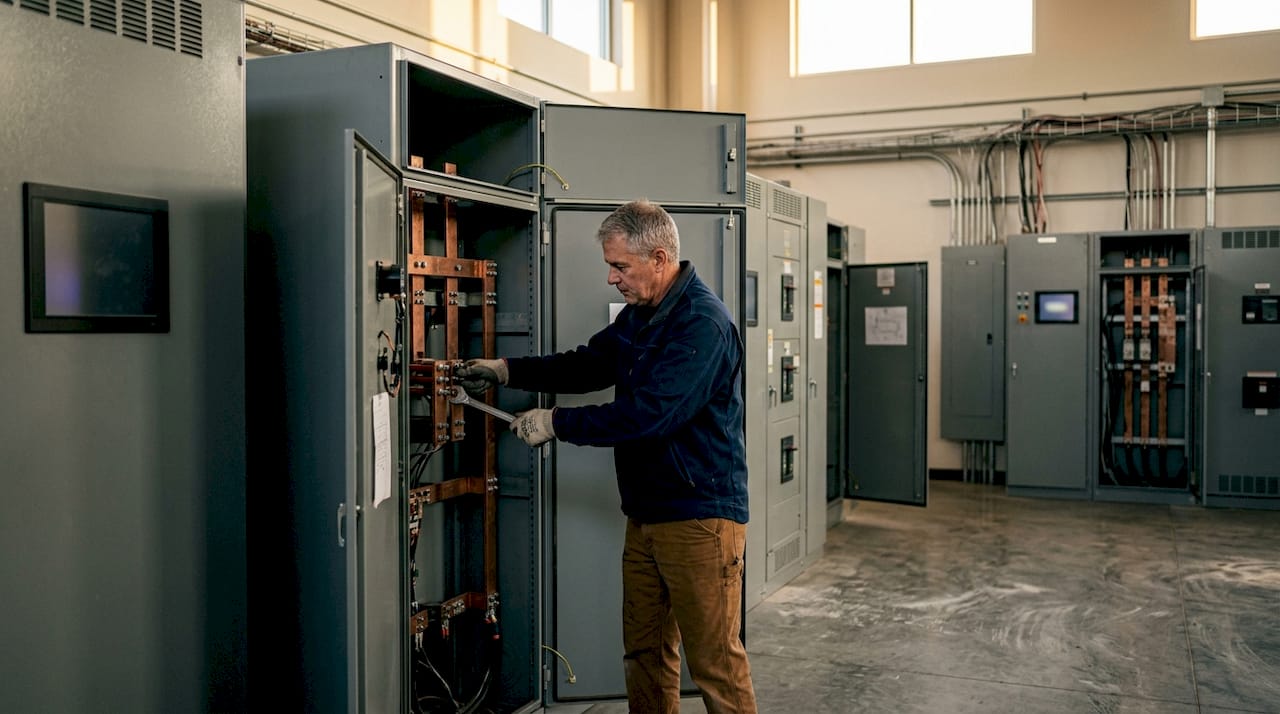
Bus bars are the copper or aluminum conductors inside a panel that carry current from the main breaker to individual circuit breakers. Commercial electrical panels use bus bars to distribute incoming power to breakers, which protect each outgoing circuit from overloads or short circuits. Bus bars are why a panel can serve dozens of circuits from a single power source without a tangle of direct connections.
Circuit breakers do two jobs: they protect circuits from damage, and they allow electricians to isolate specific areas without shutting down the whole building. This isolation capability is critical in a large office building or retail center where a total shutdown would halt operations.
Conduit and raceways protect the wiring that runs between all these components. Commercial wiring commonly uses raceways such as EMT (electrical metallic tubing), rigid metal conduit, PVC, or flexible conduit to protect and route conductors, with detailed schematics required for special circuits like emergency lighting. The conduit type chosen depends on the environment, local code, and the circuit’s purpose.
Here is a quick breakdown of the main components and their roles:
- Switchgear: Controls and protects the incoming utility feed
- Main distribution panel: Divides power into feeder circuits
- Bus bars: Carry current inside panels to individual breakers
- Circuit breakers: Protect circuits and enable zone isolation
- Conduit/raceways: Shield and organize conductors throughout the building
- Subpanels: Serve specific zones or floors from the main panel
Pro Tip: Label every breaker in every panel accurately and keep that labeling updated. Mismatched labels are the most common cause of wasted time during troubleshooting and the most common source of errors during maintenance.
How does commercial power distribution differ from residential?
The gap between commercial and residential electrical systems is wider than most business owners expect. The differences affect voltage, amperage, wiring layout, and how circuits are organized.
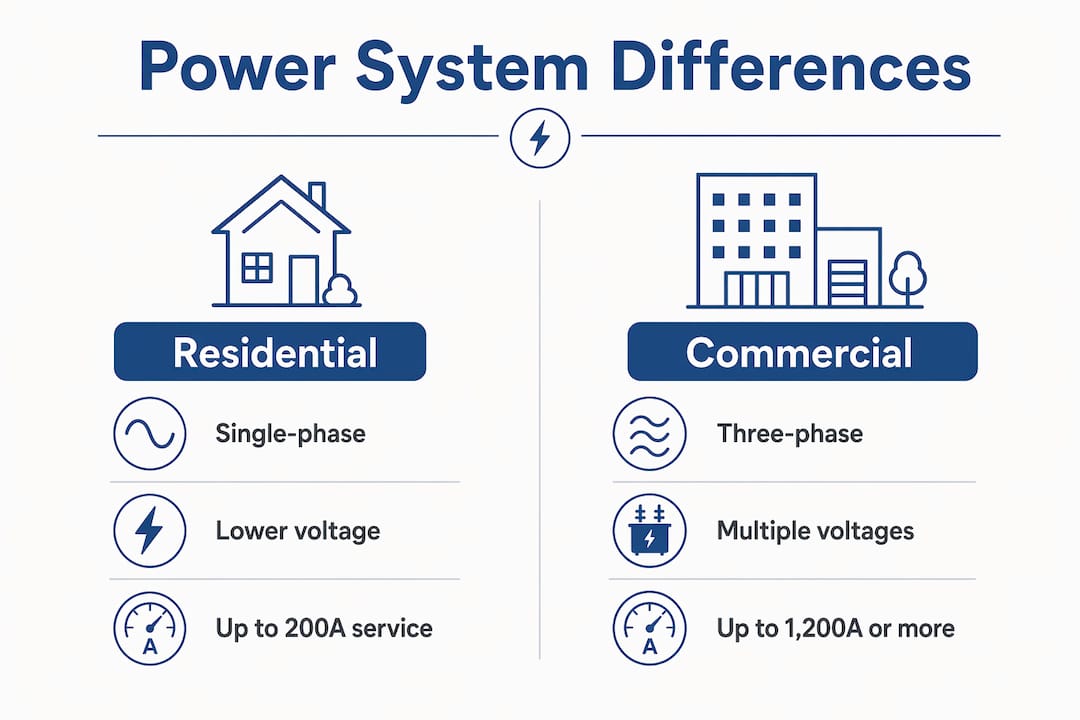
| Feature | Residential | Commercial |
|---|---|---|
| Power type | Single-phase | Three-phase |
| Common voltages | 120V / 240V | 208Y/120V, 480Y/277V |
| Service rating | 100A–200A | 200A to 4,000A+ |
| Circuit zoning | By room | By building function |
| Conduit type | Romex (NM cable) | EMT, rigid conduit, PVC |
Three-phase power enables higher power delivery with lower losses than single-phase, which is why it is the standard in commercial buildings for equipment with large loads. A residential home runs on single-phase power because its largest loads, a dryer or an oven, are modest compared to a commercial HVAC system or an elevator motor.
Commercial systems commonly have multiple voltage levels and circuit zoning with three-phase power to support larger loads like HVAC and elevators. Zoning groups circuits by building function, such as lighting, mechanical, and data, so that a tripped breaker in one zone does not affect another. That separation is what allows a restaurant kitchen to lose power to its exhaust fans without killing the dining room lights.
Service ratings tell the same story. A typical home runs on 200 amps. A mid-size commercial building may require 1,200 amps or more. That difference demands heavier conductors, larger panels, and more sophisticated protection coordination.
Why are single-line diagrams critical for commercial systems?
A single-line diagram, also called a one-line diagram, is a simplified map of the entire electrical system. It shows every major component, how they connect, and how power flows from the utility source to the last distribution point. Every commercial facility needs one, and it needs to be accurate.
A single-line diagram acts as a system-level map of major components and power flow. Its absence hampers fault isolation and maintenance accuracy. When an electrician needs to isolate a fault quickly, an accurate diagram cuts diagnostic time from hours to minutes.
The stakes go beyond convenience. Accurate single-line diagrams are required for arc-flash safety programs and coordination studies. Inaccurate drawings increase the risk of unsafe labels and maintenance errors. Arc-flash incidents are among the most severe electrical hazards in commercial settings, and the labeling that protects workers depends entirely on the diagram being correct.
Common documentation problems business owners encounter include:
- Diagrams that were never created during original construction
- Drawings that reflect the original install but not subsequent upgrades
- Panel labels that were changed during renovations without updating the diagram
- Missing documentation for emergency circuits and life-safety systems
The fix is straightforward. Commission an updated single-line diagram whenever a major upgrade occurs. Pair it with accurate preventive electrical maintenance records so the next electrician on site has a complete picture of the system. Circuit isolation in commercial distribution systems allows de-energizing specific zones via panelboard labeling, but only when documentation and labeling match the actual installed system.
What safety devices protect a commercial electrical system?
Commercial electrical safety relies on layered protection. No single device handles every hazard. The National Electrical Code (NEC) requires specific devices for specific applications, and understanding the difference between them matters.
-
Circuit breakers are the first line of defense. Breakers protect commercial circuits from overloads and faults by shutting off power to prevent fires and equipment damage. They also manage feeder circuits supplying secondary panels to maintain safe distribution across the building.
-
GFCI (Ground Fault Circuit Interrupter) devices detect current leaking outside the intended path, such as through a person. They cut power in milliseconds and are required by the NEC in wet locations like bathrooms, kitchens, and outdoor areas.
-
AFCI (Arc Fault Circuit Interrupter) devices detect the electrical signature of an arc fault, the kind of dangerous sparking that happens inside walls when wiring is damaged or connections loosen. GFCI devices detect electrical leakage to prevent shock, while AFCI devices detect arc faults to prevent fires. They serve distinct safety functions and have separate code requirements. Treating them as interchangeable is one of the most common misconceptions electricians encounter in commercial settings.
-
Grounding and bonding systems provide a safe path for fault current to return to the source, which triggers breakers to trip. Without proper grounding, fault current can energize metal enclosures and create shock hazards that no breaker will catch.
-
Surge protective devices (SPDs) guard sensitive equipment from voltage spikes caused by lightning, utility switching, or large motor starts within the building.
Pro Tip: Schedule a panel inspection after any significant renovation or equipment addition. Adding new loads changes the protection coordination of the entire system, and what was safe before the upgrade may not be safe after.
Commercial panel engineering integrates bus bars, grounding, and breaker behavior to keep the system safe. Upgrades must verify coordination and grounding, particularly in older buildings where latent risks from outdated wiring or undersized conductors may not be obvious.
Gregbeverlyservices: commercial electrical support for the Grand Strand
Gregbeverlyservices has served commercial customers across the Grand Strand area for over 40 years. The team handles everything from initial system design and panel upgrades to arc-flash documentation and circuit isolation planning.

Business owners who want a system that is safe, code-compliant, and built to handle future growth can rely on Gregbeverlyservices for honest guidance and skilled workmanship. Whether you need a full commercial electrical installation, a panel upgrade, or a system documentation review, the team brings the experience to get it right the first time. Gregbeverlyservices also installs EV chargers for commercial properties, a growing need as businesses add charging infrastructure for employees and customers. Contact Gregbeverlyservices to schedule a site assessment and get a clear picture of where your system stands.
FAQ
What is a commercial electrical system?
A commercial electrical system is a power distribution network that receives utility power, steps it down through transformers, and routes it through switchgear, panels, and branch circuits to serve a business facility. It differs from residential systems in voltage levels, load capacity, and circuit complexity.
How does three-phase power work in commercial buildings?
Three-phase power delivers electricity through three alternating current waves offset by 120 degrees, allowing higher power delivery with lower energy losses. Common commercial voltages are 208Y/120V for general use and 480Y/277V for heavy equipment and lighting.
What is a single-line diagram and why does my building need one?
A single-line diagram maps every major electrical component and shows how power flows through the system. Facilities need one for arc-flash safety labeling, maintenance accuracy, and fault isolation. An outdated or missing diagram increases both safety risk and repair time.
What is the difference between GFCI and AFCI protection?
GFCI devices detect current leaking outside the circuit path and protect against electric shock. AFCI devices detect arc faults inside wiring and protect against electrical fires. The NEC requires each in different locations, and they are not interchangeable.
How often should a commercial electrical system be inspected?
Commercial electrical systems should be inspected at least annually, and after any major renovation, equipment addition, or storm event. Regular inspections catch protection coordination issues, grounding problems, and panel overloads before they become safety hazards.
Key takeaways
Commercial electrical systems are integrated power distribution networks that require accurate documentation, layered safety devices, and proper component coordination to operate safely and reliably.
| Point | Details |
|---|---|
| Three-phase power is standard | Commercial buildings use three-phase power at 208Y/120V or 480Y/277V to support large loads efficiently. |
| Components must coordinate | Switchgear, bus bars, breakers, and conduit work as a system; a failure in one affects the whole network. |
| Single-line diagrams are required | Accurate diagrams are mandatory for arc-flash safety programs and efficient fault isolation. |
| GFCI and AFCI serve different roles | GFCI prevents shock; AFCI prevents fires. The NEC requires both in specific locations, and they are not interchangeable. |
| Documentation drives safe maintenance | Matching panel labels and diagrams to the actual installed system allows zone isolation without full shutdowns. |