
A 200-amp electrical panel upgrade is the single most effective improvement a homeowner can make to increase electrical capacity and safety in one step. The benefits of 200-amp panel upgrade projects are concrete: more usable power, modern protective devices like Arc-Fault Circuit Interrupters (AFCIs) and Ground-Fault Circuit Interrupters (GFCIs), and the headroom to add EV chargers, heat pumps, and induction ranges without rewiring your home again in five years. If your house still runs on a 100-amp panel, you are already behind the curve on both safety and capacity.
1. benefits of 200-amp panel upgrade: more usable power
A 200-amp panel delivers roughly 160 amps of usable continuous load, thanks to the NEC 80% rule that requires continuous loads to stay at or below 80% of a breaker’s rating. That rule exists to prevent overheating and overload, not to frustrate you. A standard 100-amp panel, by the same rule, gives you only 80 usable amps. That gap matters the moment you run a central air conditioner, an electric range, and a clothes dryer at the same time.
Here is what a 200-amp service can handle simultaneously that a 100-amp panel cannot:
- Central air conditioning (typically 30–50 amps)
- Electric range or double oven (40–50 amps)
- Electric clothes dryer (30 amps)
- EV charger Level 2 (32–48 amps)
- Water heater (20–30 amps)
Pro Tip: Ask your electrician to run a load calculation per NEC Article 220 before committing to any panel size. That calculation confirms whether 200 amps is sufficient or whether your home’s planned electrification actually demands a 320-amp service.
2. how many circuits does a 200-amp panel support?
A 200-amp panel supports up to 40–42 circuits, compared to the 20–24 slots common in older 100-amp panels. More slots mean you can separate high-demand circuits from low-demand ones. That separation is not just convenient. It prevents a tripped breaker in your kitchen from killing the lights in your home office.
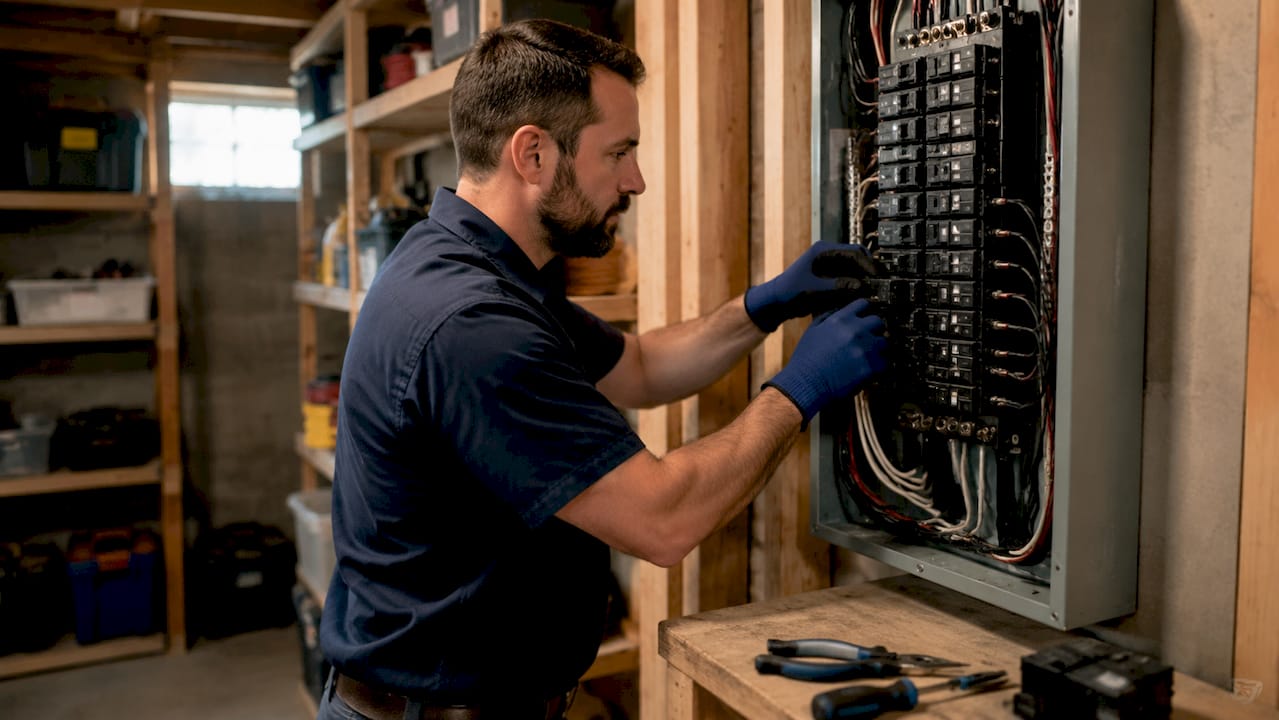
Dedicated circuits for appliances like dishwashers, refrigerators, and microwaves are now standard practice under the National Electrical Code (NEC). Older panels simply do not have the slots to accommodate them. A 200-amp panel gives you the room to do it right.
3. safety improvements that come with the upgrade
Modern 200-amp panels include AFCI and GFCI breakers that older panels cannot accommodate. AFCIs detect dangerous arcing in wiring before it starts a fire. GFCIs cut power within milliseconds when they detect a ground fault, protecting you from shock near water sources. These are not optional features. The NEC requires them in new installations and panel replacements.
The safety benefits go beyond the breakers themselves:
- Reduced risk of electrical fires from arc faults in walls and attics
- Shock protection in kitchens, bathrooms, garages, and outdoor circuits
- Lower risk of nuisance trips from overloaded circuits
- Code-compliant grounding that protects appliances and people
“Installing AFCI and GFCI breakers often drives the need for a panel upgrade because older panels cannot accommodate these devices adequately.” This is one of the most underreported reasons homeowners end up upgrading. The safety device requirement forces the panel conversation.
A licensed electrician must perform this work. Improper installation of AFCI or GFCI breakers, or a grounding system that does not meet current NEC standards, can create the exact hazards you are trying to eliminate.
4. what the upgrade actually involves
Upgrading to 200-amp service is rarely just a panel swap. A full service upgrade typically requires replacing the meter base, service entrance conductors, and the grounding system. Each of those components must be sized to handle 200 amps safely. Skipping any one of them creates a bottleneck or a code violation.
Here is the typical sequence of work:
- Licensed electrician performs a load calculation and submits permit application
- Utility company disconnects power at the meter
- Electrician replaces the panel, meter base, service entrance conductors, and grounding electrode system
- Local inspector reviews the work for NEC compliance
- Utility reconnects service
The typical project timeline runs 2–6 weeks, with most of that time spent waiting on permits and utility scheduling rather than actual labor. The cost for most homeowners falls between $1,300 and $3,000, depending on panel size, complexity, and whether the meter base and grounding system need replacement.
Pro Tip: Budget for a home inspection before or after the upgrade. Inspectors often identify related wiring issues that are far cheaper to fix while the panel is already open and the permit is active.
5. future-proofing your home for new technology
A 200-amp panel future-proofs your home for the electrification technologies that are becoming standard in American homes. EV chargers, heat pumps, induction cooktops, and whole-home battery storage systems all require dedicated high-amperage circuits. A 100-amp panel cannot support more than one or two of these without serious load management problems.
The table below shows typical electrical loads for common high-demand appliances and whether a 200-amp panel handles them comfortably:
| Appliance | Typical Load | 200-Amp Panel Suitable? |
|---|---|---|
| Level 2 EV Charger | 32–48 amps | Yes |
| Central Heat Pump | 30–50 amps | Yes |
| Induction Range | 40–50 amps | Yes |
| Whole-Home Battery (e.g., Tesla Powerwall) | 30–50 amps | Yes |
| Central AC + Electric Range + EV Charger | 100–140 amps combined | Yes, within 160-amp usable limit |
The key advantage here is headroom. Staging electrification upgrades over time, adding an EV charger now and a heat pump in three years, only works if your panel has open slots and available amperage. A 200-amp panel with 40+ circuit spaces gives you that flexibility. A maxed-out 100-amp panel does not.
Smart home devices, whole-home surge protectors, and dedicated circuits for home offices add up faster than most homeowners expect. Planning for those loads now avoids a second upgrade project later.
6. impact on home resale value
A 200-amp service upgrade improves resale value by signaling to buyers that the home is ready for modern electrical demands. Buyers shopping in 2026 are asking about EV charger readiness and heat pump compatibility before they make offers. A 100-amp panel is a negotiating point against you. A 200-amp panel with open circuits is a selling point for you.
Real estate agents in markets like the Grand Strand increasingly flag electrical capacity as a factor in buyer decisions. Homes with older panels often require a price reduction or a seller credit to cover the buyer’s future upgrade cost. Completing the upgrade before listing removes that friction entirely.
7. why a licensed electrician is non-negotiable
Load calculations per NEC Article 220 are required by inspectors to justify the service size. Errors in that calculation can result in permit denial or required rework after the fact. A licensed electrician knows how to model your home’s actual and planned loads accurately. That accuracy protects you from both undersizing and oversizing the service.
Unpermitted panel work is a serious liability. It voids homeowner’s insurance coverage for electrical fires in many policies. It creates disclosure obligations when you sell. And it leaves you with no inspection record proving the work was done correctly. The permit and inspection process exists to protect you, not to slow you down.
Key takeaways
A 200-amp panel upgrade delivers more usable power, modern safety protection, and the circuit capacity to support every major electrification technology available today.
| Point | Details |
|---|---|
| Usable capacity increases significantly | The NEC 80% rule gives a 200-amp panel 160 usable amps versus 80 amps on a 100-amp panel. |
| Safety devices require modern panels | AFCI and GFCI breakers cannot be added to most older panels without a full upgrade. |
| Upgrade scope goes beyond the panel | Meter base, service entrance conductors, and grounding system typically need replacement too. |
| Future electrification needs headroom | EV chargers, heat pumps, and battery storage all require dedicated circuits a 200-amp panel provides. |
| Resale value improves measurably | Buyers in 2026 treat 200-amp service as a baseline expectation, not a premium feature. |
What i’ve learned after watching hundreds of panel upgrades
Most homeowners come into a panel upgrade conversation focused on the immediate problem: breakers tripping, no room for an EV charger, or a home inspector flagging the panel. That is the right trigger. But the mistake I see repeatedly is sizing the upgrade to solve today’s problem rather than planning for the next ten years.
A homeowner who upgrades to 200 amps today and fills the panel with circuits for current appliances will be back in three years asking about a subpanel when they add a heat pump. The smarter move is to treat the upgrade as a platform. Leave open slots. Run a proper load calculation that accounts for planned additions, not just current usage. The NEC Article 220 load calculation is not bureaucratic overhead. It is the document that tells you whether 200 amps is actually enough or whether you should be looking at 320-amp service from the start.
The other thing worth saying plainly: the electrician you choose matters more than the panel brand. Eaton, Square D, and Siemens all make reliable 200-amp panels. The difference between a good upgrade and a problematic one is almost always the quality of the installation, the accuracy of the load calculation, and whether the grounding system was properly updated. Check for a license, pull the permit, and get the inspection. Those three steps protect everything else.
— SEO
Ready to upgrade? Gregbeverlyservices can help
Gregbeverlyservices has served residential and commercial customers across the Grand Strand for over 40 years. The team handles every part of a 200-amp service upgrade: load calculations, permitting, utility coordination, panel installation, and final inspection. You get one point of contact from start to finish, with transparent communication at every step.

If you are planning to add an EV charger or simply want a panel that meets current safety codes, Gregbeverlyservices provides a professional assessment and a clear scope of work before any project begins. Their residential electrical services cover everything from the meter base to the last circuit, all built to local code and your home’s actual needs. Contact Gregbeverlyservices today for a detailed quote.
FAQ
What does a 200-amp panel upgrade cost?
Most homeowners pay between $1,300 and $3,000 for a 200-amp panel upgrade, depending on whether the meter base, service entrance conductors, and grounding system also need replacement.
How long does a 200-amp service upgrade take?
The typical timeline runs 2–6 weeks from permit application to final inspection, with most of the wait tied to utility scheduling and local permitting rather than the installation itself.
Can i add an EV charger without upgrading my panel?
A Level 2 EV charger requires 32–48 dedicated amps. If your current panel is a 100-amp service with limited open slots, a 200-amp upgrade is almost always required before installation.
Do i need a permit for a panel upgrade?
Yes. A permit and inspection are required for panel upgrades in virtually every jurisdiction. Unpermitted work can void your homeowner’s insurance and create legal disclosure obligations when you sell.
What is the difference between a panel upgrade and a service upgrade?
A panel upgrade replaces only the breaker box. A service upgrade replaces the panel, meter base, service entrance conductors, and grounding system. Most 200-amp projects require the full service upgrade, not just the panel swap.