
Your electrical panel is the foundation of EV readiness, controlling whether your home can safely deliver the sustained power an electric vehicle charger demands. The role of electrical panel EV readiness is straightforward: your panel must provide dedicated circuits, proper overcurrent protection, and enough total capacity to handle EV charging alongside every other load in your home. Without a professional load assessment and compliance with NEC 625.41 and NEC 220.82, adding an EV charger risks tripped breakers, overheated wiring, and voided homeowner’s insurance. Greg Beverly Services has handled this exact challenge for Grand Strand homeowners for over 40 years.
How does an electrical panel support EV charging capacity?
The electrical panel distributes power from your utility service to every circuit in your home. When you add an EV charger, you are adding one of the largest continuous loads a residential panel will ever carry.
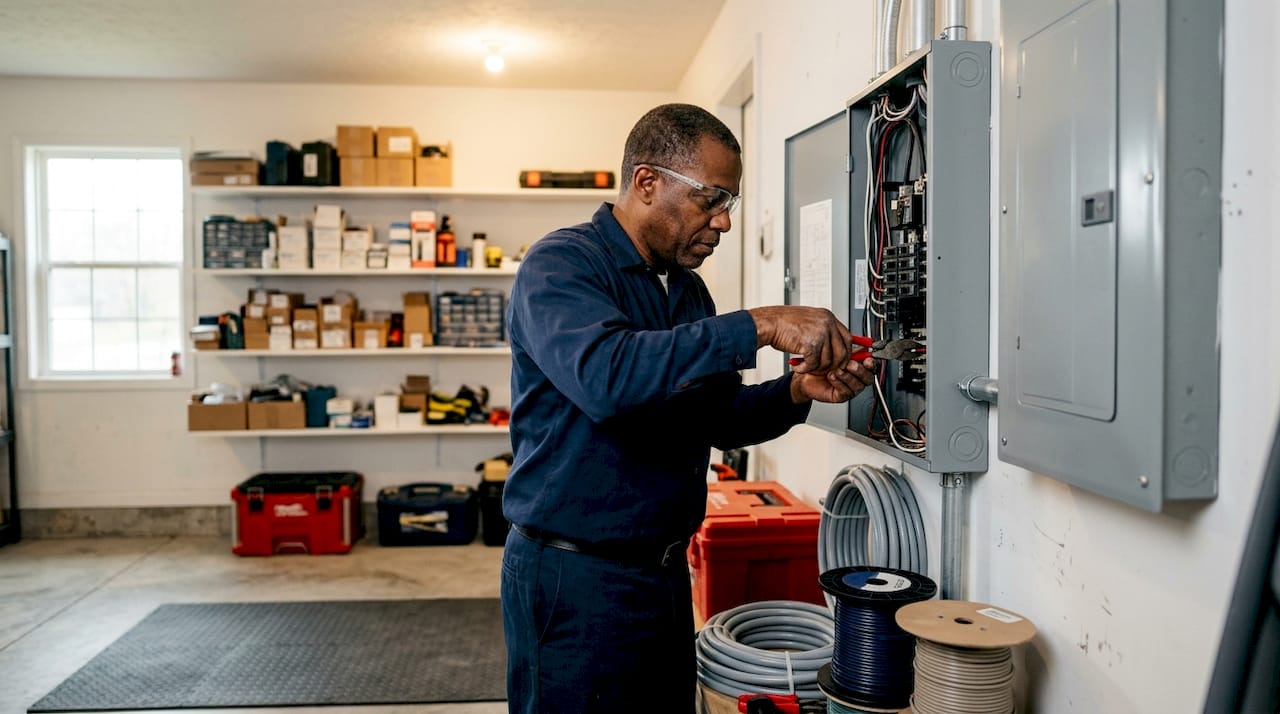
Per 2026 NEC standards, EV chargers are classified as continuous loads, meaning the circuit must be rated at 125% of the charger’s operating amperage. That rule exists because continuous loads run for three or more hours without interruption, generating heat that standard breaker ratings do not account for. A 32A Level 2 charger requires a 40A dedicated breaker. A 48A charger requires a 60A breaker.
The panel’s total capacity is calculated under NEC 220.82, which adds your home’s general load, all appliances, HVAC systems, and the new EV circuit together. If that sum exceeds your panel’s rated service amperage, you need an upgrade before installation. The calculation is not optional. Skipping it is the single most common mistake homeowners make.
- EV chargers require their own dedicated 240V circuit, not a shared branch circuit
- Breaker sizing follows the 125% continuous load rule under NEC 625.41
- NEC 220.82 load calculations determine whether your current panel can absorb the added demand
- Available breaker slots in the panel must physically accommodate the new double-pole breaker
- Wire gauge must match both the breaker rating and the distance from panel to charger
Pro Tip: A 100A panel is not automatically too small for EV charging. Run the NEC 220.82 load calculation first. Many 100A panels can support a smaller Level 2 charger through a simple circuit addition without any service upgrade.
What are the EV readiness requirements and assessment steps?
EV readiness assessment is a structured process, not a single inspection. A licensed electrician evaluates your panel, your home’s total electrical load, and the physical installation path before any work begins.
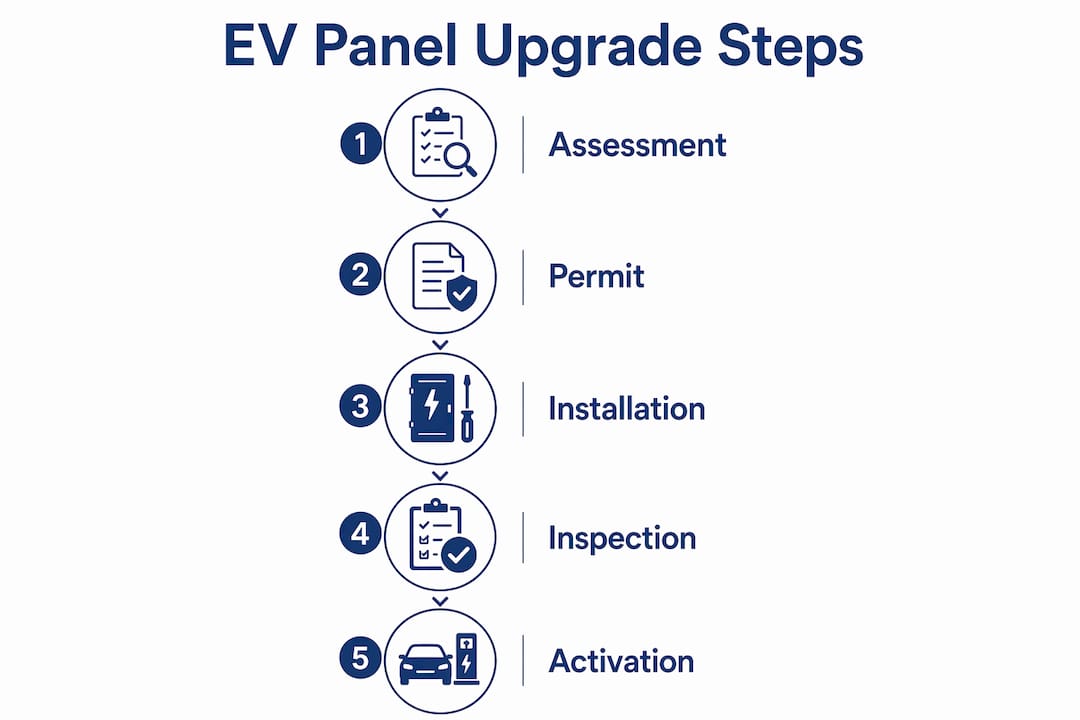
The panel upgrade process typically follows these steps:
- Load assessment. The electrician calculates your home’s total demand under NEC 220.82, including HVAC, water heater, kitchen appliances, and the proposed EV circuit. This step determines whether a simple circuit addition, a sub-panel, or a full service upgrade is necessary.
- Panel inspection. The electrician checks available breaker slots, the physical condition of the panel, and the brand. Panels like Federal Pacific Stab-Lok, Zinsco, and Challenger are fire hazards and require replacement regardless of EV charging plans.
- Permit application. A licensed contractor pulls the permit before any work starts. Unpermitted electrical work voids homeowner’s insurance and creates serious complications when you sell the property.
- Utility coordination. Service upgrades require the utility company to disconnect and reconnect the meter. This step adds scheduling time to the project and is not something a homeowner can arrange independently.
- Installation and inspection. The electrician completes the work, typically causing a power outage of 4–8 hours. A final inspection by the local authority confirms code compliance before the permit closes.
Project timelines run 1–3 weeks from assessment to final inspection, depending on permit processing speed and utility scheduling in your area.
What electrical panel upgrade options exist for EV readiness?
Not every home needs the same solution. The right upgrade depends on your panel’s current capacity, its physical condition, and how many EVs you plan to charge.
Simple circuit addition
A simple circuit addition works when your panel has available capacity under NEC 220.82 and an open breaker slot. This is the lowest-cost path, typically running $500–$1,500. It suits a single Level 2 charger on a home with a healthy 200A panel and moderate existing loads.
Sub-panel installation
A sub-panel makes sense when your main panel is physically full but the service amperage is adequate. The electrician installs a secondary panel fed from the main, creating new circuit capacity. Costs typically run $800–$2,000. This option works well for detached garages where running individual circuits from the main panel would be expensive.
Full panel replacement
Older 100A panels, or any panel from a known unsafe brand, need full replacement. A new 200A panel provides both the capacity and the safety baseline your home needs. Costs run $1,500–$4,000 depending on panel location and local labor rates. The benefits of a 200A upgrade extend well beyond EV charging, supporting future electrification like heat pumps and induction ranges.
Full service upgrade
If your home still has a 100A or 150A service from the utility, a full service upgrade brings the incoming supply to 200A or higher. This is the most involved project, coordinating with the utility company and often requiring new meter equipment. Costs run $2,000–$5,500.
| Upgrade type | Typical cost | Best for |
|---|---|---|
| Simple circuit addition | $500–$1,500 | Panel with open capacity and open slot |
| Sub-panel installation | $800–$2,000 | Full panel, adequate service amperage |
| Full panel replacement | $1,500–$4,000 | Unsafe or undersized panel |
| Full service upgrade | $2,000–$5,500 | Insufficient utility service amperage |
Pro Tip: Circuits longer than 50 feet, such as runs to a detached garage, often require a larger wire gauge to prevent voltage drop. Factor that material cost into your budget before committing to a charger location.
How does smart load management affect electrical panel EV readiness?
Smart load management gives homeowners a way to add EV charging without immediately upgrading their panel. An EV Energy Management System, or EVEMS, monitors your home’s real-time energy consumption and throttles the charger’s output when other large loads are running.
The practical effect is significant. EVEMS technology adjusts charging speed dynamically, preventing the combined load from exceeding panel capacity. A home that would otherwise need a $3,000 panel replacement might accommodate EV charging through a $300–$500 EVEMS device instead. That is not always the right answer, but it is a legitimate option worth evaluating.
- EVEMS monitors total home energy use and reduces charger amperage during peak demand
- The system restores full charging speed automatically when other loads drop
- EVEMS works best on panels that are close to capacity but not overloaded
- It does not fix unsafe panels or panels with no available breaker slots
- Planning for a second EV or additional electrification loads still points toward a full panel upgrade
Upgrading to a 200A panel also future-proofs your home for the broader shift toward home electrification. Heat pumps, electric water heaters, and induction ranges all add load. A panel sized only for today’s needs may fall short within five years. Replacing a legacy panel like a Federal Pacific Stab-Lok also removes a genuine fire risk, making the upgrade a safety improvement as much as a capacity increase.
What practical steps should homeowners take to prepare their panels?
Preparation starts with hiring a licensed electrician before you purchase a charger. The charger model you choose determines the circuit requirements, and the circuit requirements determine whether your panel needs work. Getting that sequence right saves money.
- Hire a licensed electrician first. A professional load calculation under NEC 220.82 tells you exactly what your panel can support. It costs far less than correcting a misjudged installation.
- Check your panel brand. If your home has a Federal Pacific, Zinsco, or Challenger panel, replacement is the right starting point. Adding EV charging load to a fire-hazardous panel is not a safe option.
- Understand the full timeline. Budget 1–3 weeks for the complete process. Utility coordination and permit processing drive most of the schedule, not the installation itself.
- Think beyond the first EV. If you own two vehicles or plan to in the future, size the upgrade for dual chargers now. Doing it once costs less than returning for a second project.
- Budget honestly. Know the cost range for each upgrade type before you start. A panel upgrade that surprises you mid-project is almost always one that skipped the assessment step.
Pro Tip: Ask your electrician to identify the signs your panel needs replacement during the initial assessment. Catching a failing panel before it becomes an emergency saves significantly on repair costs.
Greg Beverly Services: Expert EV charger and panel upgrade solutions
Greg Beverly Services brings over 40 years of residential electrical experience to every EV readiness project in the Grand Strand area. The team handles the full scope of work, from the initial load assessment and permit application through utility coordination and final inspection.
Whether your home needs a simple circuit addition or a complete service upgrade, Greg Beverly Services delivers honest guidance on exactly what your panel requires. No unnecessary upgrades, no guesswork on code compliance. For homeowners and property managers ready to prepare their homes for electric vehicle charging, the EV charger installation team at Greg Beverly Services is the right call. You can also explore the full range of residential electrical services to see how the team supports broader home electrification goals.
Key takeaways
Your electrical panel determines whether EV charging is safe, code-compliant, and built to handle future electrical demands without risking your home or your insurance coverage.
| Point | Details |
|---|---|
| NEC compliance is non-negotiable | EV circuits require dedicated 240V breakers sized at 125% of charger amperage per NEC 625.41. |
| Load calculation comes first | NEC 220.82 determines whether your panel needs upgrading before any charger is installed. |
| Upgrade scope varies widely | Costs range from $500 for a circuit addition to $5,500 for a full service upgrade. |
| Smart load management can delay upgrades | EVEMS technology throttles charging dynamically, letting some panels support EV charging without replacement. |
| Unsafe panels must be replaced | Federal Pacific, Zinsco, and Challenger panels are fire hazards and require replacement before adding EV load. |
FAQ
What size panel do I need for EV charging?
Most homes benefit from a 200A panel for EV charging, but a professional NEC 220.82 load calculation determines the actual requirement. Some 100A panels can support a smaller Level 2 charger through a simple circuit addition.
How long does an electrical panel upgrade take?
The full process, from assessment to final inspection, typically takes 1–3 weeks. The installation itself causes a power outage of 4–8 hours.
Can I install an EV charger without upgrading my panel?
Yes, if your panel has available capacity and an open breaker slot. An EVEMS device can also allow EV charging on panels near capacity by throttling the charger during peak demand.
Why do I need a permit for a panel upgrade?
Unpermitted electrical work voids homeowner’s insurance and creates complications when selling your property. Licensed electricians handle permit applications as part of the project.
What panels are unsafe for EV charging?
Federal Pacific Stab-Lok, Zinsco, and Challenger panels are fire hazards. These panels require full replacement before any new electrical load, including EV charging, is added.