
Handling tenant electrical repair requests is a structured process that starts with legal compliance, moves through triage and dispatch, and closes with verified documentation. Property managers who skip any step in that chain face safety risks, tenant disputes, and potential liability. The industry term for this process is maintenance request management, and electrical issues sit at the top of the priority stack because they involve life safety. This article gives you a complete workflow: from understanding your landlord obligations to dispatching licensed electricians and closing out repairs with proper records.
How to handle tenant electrical repair requests: legal obligations first
Your legal duty as a landlord is to maintain electrical systems that meet local health and safety codes. That obligation does not pause for weekends, vacancies, or budget cycles. Electricity qualifies as an essential service under most state statutes, which means failure to repair it carries serious legal consequences.
Several states spell this out explicitly. Tennessee Code Annotated § 66-28-502, for example, requires landlords to maintain electrical systems in working order. If a landlord fails to act after receiving written notice from a tenant, the tenant may arrange repairs and deduct the cost from rent. That repair-and-deduct right exists in many states, not just Tennessee. The practical implication is clear: document every request and respond fast.
Landlord electrical obligations in rental properties include:
- Maintaining wiring, outlets, and panels to meet the National Electrical Code (NEC) and local amendments
- Responding to written repair notices within the timeframe required by state law, typically 14–30 days for non-emergency issues
- Treating electricity as an essential service, meaning loss of power to a unit triggers urgent response requirements
- Keeping records of all repair requests, responses, work orders, and completed repairs for at least the duration of the tenancy
- Hiring licensed electricians for any work that requires a permit, which covers panel replacements, new circuits, and most wiring repairs
Formal written documentation is not optional. A text message or verbal report does not create the paper trail you need if a tenant later files a habitability complaint or pursues legal action. Build a system that captures every request in writing from day one.
How do you triage and prioritize electrical repair requests?
Triage is the practice of sorting repair requests by urgency before dispatching anyone. For electrical issues, getting this wrong is not just inefficient. It is dangerous.
Industry standards as of 2026 define three response tiers for electrical repairs:
- Emergency (immediate action): Arcing, burning smells, sparks, total power loss, exposed wiring, or any sign of fire risk. Dispatch a licensed electrician within the hour regardless of time of day.
- Urgent (4–8 hours): Partial power loss affecting multiple rooms, a circuit breaker that trips repeatedly, or outlets that are warm to the touch. These are not yet emergencies but can become one quickly.
- Standard (24–48 hours): A single non-functioning outlet, a light fixture that stopped working, or a switch that does not respond. These are inconveniences, not hazards.
Treat all arcing or burning smells as fire hazards requiring immediate emergency service, regardless of the time of day. This is a non-negotiable rule. A burning smell from an outlet at 2 a.m. on a Saturday is an emergency call, not a Monday morning ticket.
One triage skill that saves money is distinguishing nuisance breaker trips from structural hazards. A breaker that trips once after a tenant plugs in too many appliances is a nuisance trip. A breaker that trips repeatedly on a lightly loaded circuit signals a wiring fault or panel problem. Knowing the difference prevents unnecessary emergency service calls and focuses your licensed electrician on real hazards.
Pro Tip: Build a symptom checklist into your intake form with dropdown options: “burning smell,” “sparks visible,” “breaker tripping repeatedly,” “single outlet not working.” Tenants who select from a list give you more accurate data than tenants who write a free-text description.
What is the step-by-step process to manage electrical repairs?
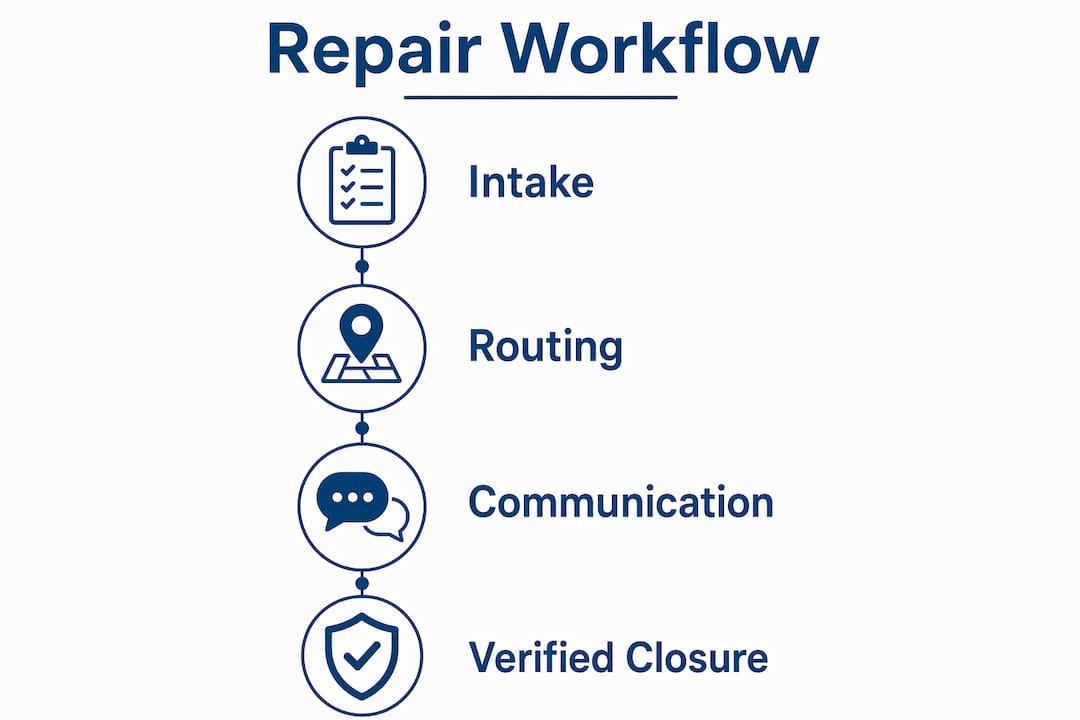
The most reliable repair workflows follow four stages: intake, routing, communication, and verified closure. Each stage has a specific output that feeds the next one.
Stage 1: Intake
Collect a standardized request form that requires the tenant to provide the unit number, a symptom description, photos of the affected area, and available access times. Photos are not optional. Documented requests with photos are the primary evidence you need to charge a tenant for damage caused by misuse rather than normal wear. A form with required fields and dropdown symptom categories produces consistent, routable data every time.

Stage 2: Routing
Route the completed request to a licensed electrician based on the triage tier assigned during intake. Emergency requests go to your on-call electrician immediately. Urgent and standard requests route to your primary vendor during business hours. Standardized intake with photos and access instructions enables roughly 33% faster median resolution times compared to uncoordinated approaches. The bottleneck in electrical repair resolution is almost always scheduling coordination, not technician skill.
Stage 3: Communication
Send the tenant a confirmation message within one hour of receiving the request. Include the assigned tier, the expected response window, and the name of the electrician or company dispatched. Update the tenant when the appointment is scheduled and again when the technician is en route. Tenants who receive regular updates report significantly higher satisfaction even when repairs take longer than expected.
Stage 4: Verified closure
Require the electrician to submit after-photos and a written scope of work upon completion. Compare the scope against the original request to confirm the issue was fully resolved. Send the tenant a closure notification and ask for confirmation that the repair is satisfactory. File all records, including before-photos, work orders, invoices, and after-photos, in the property’s maintenance log.
The table below maps each stage to its required output and responsible party.
| Stage | Required output | Responsible party |
|---|---|---|
| Intake | Completed form with photos and access times | Tenant (submitted) / Manager (verified) |
| Routing | Work order assigned to licensed electrician | Property manager |
| Communication | Confirmation, scheduling update, en-route alert | Property manager |
| Verified closure | After-photos, scope of work, tenant sign-off | Electrician and property manager |
Pro Tip: Add a line to your electrician contracts requiring a written scope of work at job completion. Contracts should specify conductor materials and breaker compatibility to prevent post-work disputes about what was actually done.
What are the most common challenges in handling electrical repair requests?
Property managers consistently run into the same five problems when managing electrical repairs. Recognizing them early prevents costly mistakes.
- Misclassifying emergencies as standard requests. A tenant who reports “the lights are flickering” may be describing a loose connection that is one step from an arc fault. When in doubt, escalate. The cost of an unnecessary emergency call is far lower than the cost of a fire or a habitability lawsuit.
- Insufficient documentation. Without photos, written descriptions, and signed work orders, you cannot prove what the condition of the unit was before or after a repair. This gap creates liability in tenant disputes and makes it nearly impossible to recover costs for tenant-caused damage.
- Scheduling coordination bottlenecks. The primary delay in electrical repair resolution is scheduling, not the repair itself. Properties without a preferred vendor list or on-call electrician agreement spend hours finding available technicians while the tenant waits.
- Poor tenant communication. Silence after a repair request is the fastest way to generate a complaint or a negative review. A single automated confirmation message cuts follow-up calls dramatically.
- No escalation protocol. If a standard request is not assigned within 48 hours, it should automatically escalate to urgent status. Without a defined escalation rule, requests fall through the cracks.
What tools and practices improve electrical repair workflows?
The right tools reduce manual work and produce better outcomes for both property managers and tenants.
Digital intake portals replace email and phone calls with structured forms. A good portal requires symptom selection from a predefined list, photo uploads, and preferred access times before submission. Standardized forms with dropdown categories improve routing accuracy and reduce back-and-forth with tenants.
Automated routing and escalation systems assign incoming requests to the correct vendor tier without manual review. They also trigger escalation alerts when response windows are missed. This removes the human error that causes standard requests to sit unassigned for days.
Vendor service agreements define the scope of work, response times, licensing requirements, and billing terms before any repair is needed. A well-written agreement for electrical service work specifies circuit ratings, conductor types, panel locations, patching responsibilities, and required permits. That level of detail eliminates most post-repair disputes.
Preventive maintenance programs reduce the volume of emergency requests over time. A preventive electrical maintenance program typically includes annual panel inspections, outlet and switch testing, and GFCI verification. Properties that run these programs see fewer urgent and emergency tickets because problems are caught before they become failures.
The table below compares two common approaches to managing electrical repair workflows.
| Feature | Manual process | Digital workflow |
|---|---|---|
| Request intake | Phone or email, inconsistent data | Structured form with required fields and photos |
| Routing | Manual assignment, prone to delay | Automated by tier and vendor availability |
| Tenant updates | Ad hoc, often skipped | Triggered at each stage automatically |
| Closure verification | Verbal confirmation only | After-photos and written scope required |
| Audit trail | Scattered across email and notes | Centralized, searchable, exportable |
Pro Tip: Track median resolution time by repair category each quarter. If electrical repairs consistently exceed the 13.1-day median seen in self-managed properties, your intake or scheduling process needs attention.
Key Takeaways
Effective electrical repair management requires a documented, tiered workflow from intake through verified closure to protect both tenants and property managers from safety risks and legal liability.
| Point | Details |
|---|---|
| Legal obligations come first | Landlords must maintain electrical systems as an essential service and respond to written notices promptly. |
| Triage by urgency | Classify requests as emergency, urgent, or standard and dispatch within defined timeframes. |
| Standardize intake with photos | Require symptom descriptions and photos at submission to speed routing and support dispute resolution. |
| Verify closure in writing | Collect after-photos and a written scope of work from every electrician before closing a ticket. |
| Prevent delays with vendor agreements | Pre-negotiated service agreements with licensed electricians eliminate scheduling bottlenecks. |
Gregbeverlyservices: licensed electrical support for property managers
Property managers in the Grand Strand area need a reliable electrical partner, not a vendor they have to track down every time a tenant reports a problem. Gregbeverlyservices brings over 40 years of licensed electrical experience to residential repair requests of every scale, from a single faulty outlet to a full panel replacement.

Gregbeverlyservices serves property managers across the Grand Strand with rapid response, transparent communication, and work that meets local safety codes. Every job comes with a clear scope of work and documented completion, giving you the paper trail your maintenance records require. Whether you manage a single rental unit or a portfolio of properties, Gregbeverlyservices delivers the consistent, licensed workmanship that keeps your tenants safe and your properties compliant. Contact Gregbeverlyservices to set up a service agreement before the next repair request arrives.
FAQ
What are a landlord’s electrical repair obligations?
Landlords must maintain electrical systems that meet health and safety codes and treat electricity as an essential service. Failure to act after written tenant notice can trigger repair-and-deduct rights under state law.
How quickly should I respond to a tenant electrical complaint?
Emergency electrical issues require immediate dispatch. Urgent issues should be assigned within 4–8 hours, and standard requests within 24–48 hours, per 2026 industry standards.
Why does documentation matter for electrical repairs?
Documented requests with photos and written work orders are the primary evidence needed to resolve tenant disputes and recover costs for tenant-caused damage.
How do I reduce electrical repair delays?
The main delay is scheduling coordination, not technician skill. Pre-negotiated vendor agreements and digital intake forms with photos and access times cut resolution time significantly.
Do I need a licensed electrician for all rental property repairs?
Any electrical work requiring a permit, including panel replacements, new circuits, and most wiring repairs, must be performed by a licensed electrician to meet code and protect your liability.