
Electrical service size is determined by calculating your property’s total electrical load in volt-amperes (VA), then dividing that number by 240 volts and rounding up to the next standard service rating. The National Electrical Code (NEC) provides the formal framework for this process, and the industry term is “dwelling unit load calculation.” Standard residential service ratings run at 100 amps, 125 amps, 150 amps, and 200 amps. Knowing how electrical service size is determined protects you from undersized panels, failed inspections, and costly mid-project surprises.
How is electrical service size determined by NEC load calculation?
Residential electrical service sizing follows two NEC-approved paths: the Standard Method and the Optional Method under NEC 220.82. Both convert your home’s total electrical demand into amperage, but they apply demand factors differently.
The Standard Method
The Standard Method adds up every load category individually. General lighting starts at 3 VA per finished square foot, excluding garages and unfinished basements. A 2,000 square foot finished home carries 6,000 VA in general lighting load before you add a single appliance. Small appliance circuits add 1,500 VA each, and the laundry circuit adds another 1,500 VA. You then apply demand factors to the combined total before converting to amps.

The Optional Method (NEC 220.82)
The Optional Method is faster and more commonly used for single-family homes. It calculates 100% of the first 10,000 VA, then applies a 40% factor to everything above that threshold. The logic behind the 40% tier is load diversity: not all appliances run at full power simultaneously, so the code allows a realistic reduction. You then add the larger of your heating or cooling load, not both, because heating and cooling are non-coincident loads.
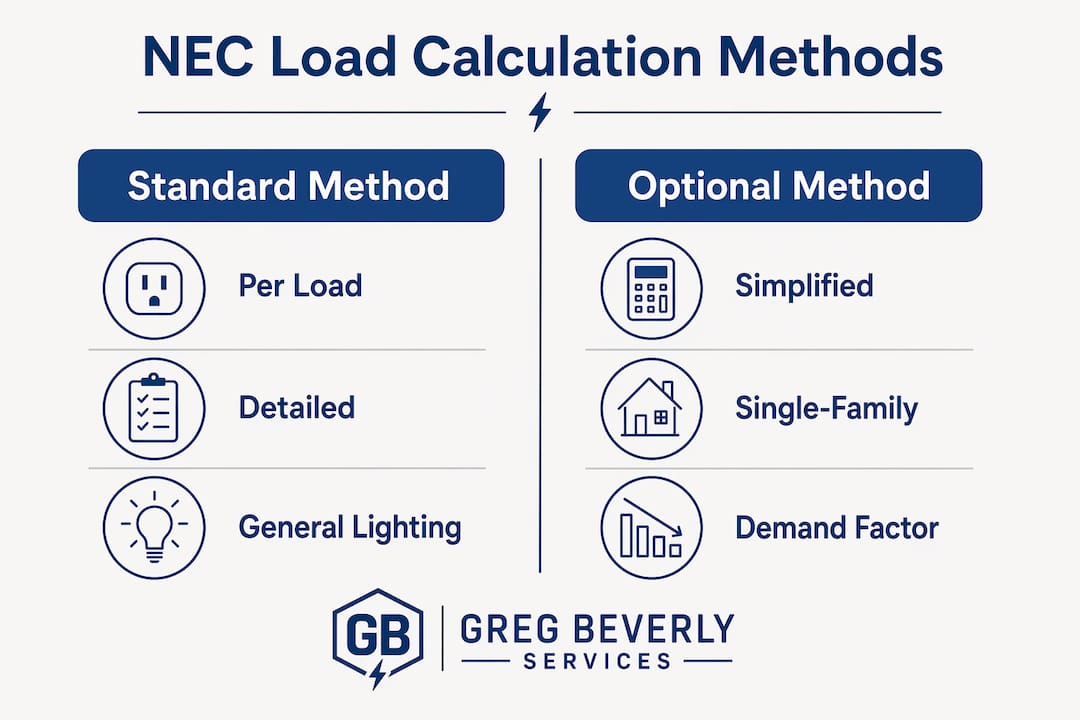
Here is how the two methods compare at a glance:
| Feature | Standard Method | Optional Method (NEC 220.82) |
|---|---|---|
| Demand factor application | Per load category | 100% first 10 kVA, 40% remainder |
| HVAC treatment | Both loads may apply | Larger of heating or cooling only |
| Complexity | Higher | Lower |
| Best for | New or complex loads | Most single-family dwellings |
| NEC reference | NEC 220.40 | NEC 220.82 |
Once you total your VA demand, divide by 240 volts and round up. One real example totals 27,340 VA divided by 240V, producing 114 amps and leading to a 125-amp service selection. NEC 230.79© sets the floor at 100 amps for any single-family dwelling, regardless of what your calculation produces. Most modern homes land at 200 amps to handle electrification loads comfortably.
Pro Tip: Not every home qualifies for the Optional Method. Check NEC 220.82 eligibility criteria before using it. If your home does not qualify, the Standard Method applies and can produce a different required service size.
What factors affect electrical service size beyond the math?
The calculation gives you a number. Real-world factors determine whether that number is actually enough.
Major appliances drive the biggest load additions. Electric ranges, electric dryers, water heaters, HVAC systems, and EV chargers all carry specific nameplate ratings that feed directly into your load calculation. Nameplate ratings, not breaker sizes, are what the NEC requires you to use. Guessing or estimating from a panel’s fullness is one of the most common sizing mistakes homeowners and contractors make.
Key factors that influence your final service size include:
- EV chargers: A Level 2 charger typically draws 48 amps at 240V, adding significant load to any calculation.
- Electric HVAC systems: Heat pumps and central air units carry large nameplate ratings that often determine the HVAC load tier.
- Electric ranges and ovens: These carry demand factors under NEC Table 220.55 but still add thousands of VA.
- Future additions: Planning a home addition, a pool, or a second EV charger changes your load picture entirely.
- Local AHJ rules: Local code adoption and AHJ interpretation affect which calculation method applies and what the utility will approve.
Load diversity is the reason demand factors exist. Statistical experience shows that full simultaneous operation of every major appliance is very unlikely. That reality is built into the 40% tier of NEC 220.82. Many installers go one step further and select the next standard size above the calculated amperage, moving from a 150-amp result to a 200-amp service for headroom and future-proofing.
Pro Tip: Before your electrician runs the load calculation, gather the exact manufacturer spec sheets for every major appliance, including the operating mode that draws peak power. A dryer’s nameplate rating in heat mode differs from its standby draw.
How does commercial service sizing differ from residential?
Commercial electrical service sizing uses the same NEC Chapter 220 framework but applies different occupancy-based metrics. Residential calculations start with 3 VA per square foot for general lighting. Commercial occupancy types carry their own VA per square foot figures: offices run at 3.5 VA per square foot, retail spaces at 3.0 VA per square foot, and warehouses fall lower. These figures reflect the actual lighting and receptacle density typical for each occupancy type.
Commercial sizing also involves more moving parts than a residential project:
- Demand factors from NEC 220.42 apply to lighting loads based on total connected load thresholds, reducing the calculated demand for large buildings.
- Utility coordination is required earlier in the process. Commercial services often involve three-phase power, transformer sizing, and utility-side engineering that residential projects rarely need.
- Panel size and service size diverge more often. A commercial building may have a 400-amp service feeding multiple sub-panels, each sized for a specific tenant or floor.
- AHJ requirements vary significantly. Local jurisdictions in the Grand Strand area and elsewhere may require engineering stamps, load schedules, and utility pre-approval before a commercial service is finalized.
- Occupancy changes trigger recalculation. Converting a warehouse to retail space changes the VA per square foot baseline and may require a full service upgrade.
The practical takeaway for property managers is that commercial service sizing is not a DIY calculation. Engineering input and utility coordination are standard parts of the process, not optional extras.
How do you verify your existing electrical service size?
The fastest way to identify your current service size is to locate your main breaker. The number printed on the main breaker or fuse represents your panel’s rated capacity in amps. It is usually labeled “Main” or “Service Disconnect” and sits at the top of your breaker panel. A 200-amp main breaker means your panel is rated for 200 amps.
That number is not always the whole story. Your panel’s rated capacity and your actual service capacity can differ. The service conductors running from the utility meter to your panel determine the true maximum. Undersized service conductors limit capacity even if your panel is rated higher. Checking what the service lateral delivers to your home gives you the full picture.
Steps to verify your service size accurately:
- Locate the main breaker and read the amperage rating printed on it.
- Check the panel label inside the door for the manufacturer’s listed service rating.
- Inspect the service entrance conductors for wire gauge, which indicates maximum ampacity.
- Call your local utility company and ask for the service size on record for your address.
- Have a licensed electrician confirm the rating if any of the above steps produce conflicting information.
Permit reviews also affect your allowable service size. When you pull a residential electrical permit for a panel upgrade or new service, the AHJ reviews your load calculation as part of the approval process. That review can require changes to your planned service size before work begins.
Pro Tip: If you are planning an upgrade, check whether your meter base and service entrance equipment are rated for the new amperage before ordering a panel. Upgrading from 100 amps to 200 amps often requires replacing the meter base and service conductors, not just the panel.
Key Takeaways
Electrical service size is determined by a formal NEC load calculation that converts total VA demand into amperage, then rounds up to the next standard service rating.
| Point | Details |
|---|---|
| NEC sets the calculation method | Use NEC 220.82 Optional Method or Standard Method to calculate total VA demand before sizing. |
| Divide by 240V to find amps | Total VA divided by 240 volts gives required amperage; always round up to the next standard rating. |
| 100-amp minimum is the floor | NEC 230.79© requires at least 100 amps for any single-family dwelling, regardless of calculated load. |
| Nameplate ratings drive accuracy | Use manufacturer nameplate data for every major appliance; guessing from breaker size causes errors. |
| Plan for future loads | Selecting one size above your calculated need provides headroom for EV chargers and electrification. |
Gregbeverlyservices can size and upgrade your electrical service
Gregbeverlyservices has served residential and commercial customers in the Grand Strand area for over 40 years. The team handles full NEC load calculations, permit coordination, and AHJ submissions so you do not have to interpret code language on your own.

Whether you need a panel amperage upgrade, a new EV charger installation, or a complete residential electrical service assessment, Gregbeverlyservices brings the code knowledge and field experience to get it right the first time. Contact Gregbeverlyservices for a consultation and get a clear, honest answer about what your property actually needs.
FAQ
What is the minimum electrical service size for a home?
NEC 230.79© requires a minimum of 100 amps for any single-family dwelling. Most modern homes are built or upgraded to 200 amps to handle current and future electrical loads.
How do I calculate the electrical service size I need?
Total your home’s electrical loads in volt-amperes using NEC 220.82 or the Standard Method, then divide by 240 volts and round up to the next standard service rating such as 125, 150, or 200 amps.
Does adding an EV charger require a service upgrade?
A Level 2 EV charger typically draws 48 amps at 240V. Adding one to a home already near its service capacity often requires a panel or service upgrade to maintain code compliance and safe operation.
Can my panel size differ from my actual service size?
Yes. Your panel’s rated amperage and your actual service capacity can differ if the service entrance conductors or meter base are undersized. A licensed electrician can confirm both figures during an inspection.
Do online load calculators give accurate results?
Online calculators are starting points, not final answers. Local code editions, AHJ interpretations, and utility requirements all affect the final approved service size and must be verified with a licensed professional.